
A biomarker assessment of pesticide toxicity in endemic, native peregrine, and invasive earthworm species from the Muthalamada mango plantations, Kerala, India
DOI:
https://doi.org/10.63095/NBSEH.25.850535Keywords:
Earthworms, Pesticides, Toxicity, Enzyme biomarkers, Mango plantationsAbstract
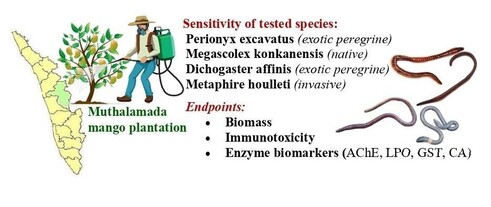
This study assessed the toxic effects of pesticide exposure on four earthworm species: Perionyx excavatus Perrier, 1872; Megascolex konkanensis Fedarb, 1898; Dichogaster affinis (Michaelsen, 1890); and Metaphire houlleti (Perrier, 1872). The organisms were exposed to pesticide-treated soil. Biomass reduction, immunotoxicity, and enzyme biomarkers were used as endpoints. Among the tested species, M. konkanensis, a native species, appeared more sensitive than the others. In biomass tests, chlorpyrifos showed no significant effect on final body mass (p > 0.05). P. excavatus showed a significant reduction in body mass between 0.001 and 0.02 ppm of the pesticide mixture (p < 0.05), and exhibited avoidance behaviour. M. konkanensis showed avoidance at 0.02 ppm of the mixture but not at lower concentrations. Changes in AChE, LPO, GST, and CAT activities indicated pesticide-related stress. These results support the use of P. excavatus, D. affinis, and M. houlleti as indicators for soil contamination by pesticides.
Downloads
References
Gong, P., Guan, X., Pirooznia, M., Liang, C., & Perkins, E.J., 2012, Gene expression analysis of CL-20-induced reversible neurotoxicity reveals GABAA receptors as potential targets in the earthworm Eisenia fetida. Environmental Science and Technology 46, 1223-1232. https://doi.org/10.1021/es203642e
Svendsen, C., Spurgeon, D.J., Hankard, P.K., & Weeks, J.M., 2004, A review of lysosomal membrane stability measured by neutral red retention: is it a workable earthworm biomarker?. Ecotoxicolgy and Environmental Safety 57, 20-29. https://doi.org/10.1016/j.ecoenv.2003.08.009
Kammenga, J.E., Dallinger, R., Donker, M.H., Kohler, H.R., Simonsen, V., Triebskorn, R., & Weeks, J.M., 2000, Biomarkers in terrestrial invertebrates for ecotoxicological soil risk assessment. Review of Environmental Contamination and Toxicology 164, 93-148. https://europepmc.org/article/med/12587835
Gong, P., & Perkins, E.J., 2016, Earthworm toxicogenomics: a renewed genome-wide quest for novel biomarkers and mechanistic insights. Applied Soil Ecology 104, 12-24. https://doi.org/10.1016/j.apsoil.2015.11.005
Lionetto, M.G., Calisi. A., & Schettino, T., 2012, Earthworm biomarkers as tools for soil pollution assessment. Soil Health and Land Use Management 16, 305-331. 10.5772/28265
Daewoo, M., Wahid, A., Hashmi, M.Z., Mukhtar, S., & Malik, Z. 2017, Use of earthworms in biomonitoring of soil xenobiotics. In : Xenobiotics in the Soil Environment (Springer), pp. 73-88. https://link.springer.com/chapter/10.1007/978-3-319-47744-2_6
Calisi, A., Latino, M.E., Corallo, A., Grimaldi, A., Ferronato, C., Antisari, L.V., & Dondero, F., 2019, Biomarkers in soil organisms: their potential use in the assessment of soil pollution and remediation. In: Bioremediation of Agricultural Soils, pp. 262-285. https://irinsubria.uninsubria.it/handle/11383/2078820
Hirano, T., & Tamae, K., 2011, Earthworms and soil pollutants. Sensors 11, 11157-11167. https://doi.org/10.3390/s111211157
Devi, S.H., Vijayalakshmi, K., Jyotsna, K.P., Shaheen, S.K., Jyothi, K., & Rani, M.S., 2009, Comparative assessment in enzyme activities and microbial populations during normal and vermicomposting. Journal of Environmental Biology 30, 1013-1017. Available online at : http://www.jeb.co.in/journal_issues/200911_nov09/paper_15.pdf (Consulted on 19 April 2025)
Liu, T., Wang, X., You, X., Chen, D., Li, Y., & Wang, F., 2017, Oxidative stress and gene expression of earthworm (Eisenia fetida) to clothianidin. Ecotoxicology and Environmental Safety 142, 489-496. https://doi.org/10.1016/j.ecoenv.2017.04.012
Robidoux, P.Y., Hawari, J., Bardai, G., Paquet, L., Ampleman, G., Thiboutot, S., & Sunahara, G.I., 2002, TNT, RDX, and HMX decrease earthworm (Eisenia andrei) life-cycle responses in a spiked natural forest soil. Archives of Environmental Contamination and Toxicology 43, 0379-0388. https://link.springer.com/article/10.1007/s00244-002-1242-z
Gautam, A., Ray, A., Manna, S., Sarkar, M.P., Ghosh, A.R., Ray, M., & Ray, S., 2020, Shift in phagocytosis, lysosomal stability, lysozyme activity, apoptosis and cell cycle profile in the coelomocytes of earthworm of polluted soil near a tannery field of India. Ecotoxicolgy and Environmental Safety 200, 110713. https://doi.org/10.1016/j.ecoenv.2020.110713
Wang, Z., & Cui Z., 2016, Accumulation, biotransformation, and multi-biomarker responses after exposure to arsenic species in the earthworm Eisenia fetida. Toxicology Research 5, 500-510. https://doi.org/10.1039/c5tx00396b
Irizar, A., Rivas, C., García-Velasco, N., de Cerio, F.G.J., Etxebarria, Marigómez, I,. & Soto, M., 2015, Establishment of toxicity thresholds in subpopulations of coelomocytes (amoebocytes vs. eleocytes) of Eisenia fetida exposed in vitro to a variety of metals: implications for biomarker measurements. Ecotoxicology 24,1004-1013. https://link.springer.com/article/10.1007/s10646-015-1441-9
Mincarelli, L., Vischetti, C., Craft, J., & Tiano, L., 2016, DNA damage in different Eisenia andrei coelomocytes sub-populations after in vitro exposure to hydrogen peroxide. Springer Plus 5, 1-7. https://doi.org/10.1186/s40064-016-1950-x
Li, W., Wang, C., & Sun, Z., 2011, Vermi pharmaceuticals and active proteins isolated from earthworms. Pedobiology 54, S49-S56. https://doi.org/10.1016/j.pedobi.2011.09.014
Lourenço, J., Silva, A., Carvalho, F., Oliveira, J., Malta, M., Mendo, S., Gonçalves, F., & Pereira, R., 2011, Histopathological changes in the earthworm Eisenia andrei associated with the exposure to metals and radionuclides. Chemosphere 85,1630-1634. https://doi.org/10.1016/j.chemosphere.2011.08.027
Jeyaprakasam, A., Muniyandi, B., James, A.J.P., Karmegam, N., & Ponnuchamy, K., 2021. Assessment of earthworm diversity and pesticide toxicity in Eudrilus eugeniae. Environmental Chemistry and Ecotoxicolgy 3, 23-30. https://doi.org/10.1016/j.enceco.2020.11.001
Reddy, N.C., & Rao, J.V., 2008. Biological response of earthworm, Eisenia fetida (Savigny) to an organophosphorous pesticide, profenophos. Ecotoxicolgy and Environmental Safety 71, 574-582. https://doi.org/10.1016/j.ecoenv.2008.01.003
Blakemore R.J., 2009 Cosmopolitan earthworms: a global and historical perspective. Annelids in modern biology (ed. D.H. Shain), (Hoboken: John Wiley), pp. 257–283. https://doi.org/10.1002/9780470455203.ch14
Gates, G.E., 1973, Burmese earthworms, an introduction to the systematic and biology of the megadrile oligochaetes with special reference to Southeast Asia. Transactions of the American Philosophical Society 62(7), 1–326. https://doi.org/10.2307/2412107
Julka, J.M., 1988, The Fauna of India and Adjacent Countries. Megadrile
Oligochaeta (Earthworms). Haplotaxida: Lumbricina: Megascolecoidea:
Octochaetidae, (Calcutta: Zoological Survey of India). https://archive.org/details/dli.zoological.fi.028
Stephenson, J. 1923. The Fauna of British India, including Ceylon and Burma, Oligochaeta. (London: Taylor and Francis, London). https://www.nature.com/articles/113455b0#:~:text=Abstract,30s.
Narayanan, S.P., Ahmed, S., & Thomas, A. P., 2025, Description of a new species of the earthworm genus Moniligaster Perrier, 1872 (Clitellata, Moniligastridae) from the Nilgiri Biosphere Reserve of Tamil Nadu State, India. Zootaxa 5589(1), 142-154. https://doi.org/10.11646/zootaxa.5589.1.12
Narayanan, S.P., Kurien, V.T., Anuja, R., Hasyagar, V., Thomas, A.P., Paliwal, R., & Julka, J.M., 2023, Earthworm (Clitellata, Megadrili) fauna of Kuttanad wetland, southern part of Vembanad-Kol Ramsar site, India. Opuscula Zoologica Budapest 54(1), 3-21. https://doi.org/10.18348/opzool.2023.1.3
Anderson, J.M., & Ingram, J.S.I., 1994, Tropical Soil Biology and Fertility: A Handbook of Methods. Soil Science 157(4), 265. https://dx.doi.org/10.2307/2261129
Jhulka, J.M. (1993). Earthworm resources in India and their utilization in vermiculture. In: A.K., Ghosh (Ed.) Earthworm Resource and Vermiculture, Zoological Survey of India, Kolkata, India, pp. 51-56
OECD, 1984, Guideline for testing of chemicals, Earthworms: acute toxicity tests. (Paris: Organization for Economic Cooperation and Development) 207(OECD, Paris. https://doi.org/10.1787/9789264070042-en
OECD, 2004, Test No. 222: Earthworm Reproduction Test (Eisenia fetida/Eisenia andrei) (Paris: OECD Publishing). https://doi.org/10.1787/9789264070325-en.
Reinecke, S.A., & Reinecke, A.J., 2007. Biomarker response and biomass change of earthworms exposed to chlorpyrifos in microcosms. Ecotoxicology and Environmental Safety 66, 92-101. https://doi.org/10.1016/j.ecoenv.2005.10.007
Shi, Y., Shi,Y., Wang, X., Lu, Y., & Yan, S., 2007, Comparative effects of lindane and deltamethrin on mortality, growth, and cellulase activity in earthworms (Eisenia fetida). Pesticide Biochemistry and Physiology 89, 31-38. https://doi.org/10.1016/j.pestbp.2007.02.005
Diogene, J., Dufour, M., Poirier, G.G., & Nadeau, D., 1997, Extrusion of earthworm coelomocytes: comparison of the cell populations recovered from the species Lumbricus terrestris, Eisenia fetida and Octolasion tyrtaeum. Laboratory Animal 31, 326-336. https://doi.org/10.1258/002367797780596068
Eyambe, G.S., Goven, A.J., Fitzpatrick, L.C., Venables, B.J., & Cooper, E.L., 1991, A non-invasive technique for sequential collection of earthworm (Lumbricus terrestris) leukocytes during subchronic immunotoxicity studies. Laboratory Animal 25, 61-67. https://doi.org/10.1258/002367791780808095
Saint-Denis, M., Labrot, F., Narbonne, J.F., & Ribera, D., 1998, Glutathione, glutathione-related enzymes, and catalase activities in the earthworm Eisenia fetida/andrei. Archives of Environmental Contamination and Toxicology 35, 602-614. https://link.springer.com/article/10.1007/s002449900422
Habig, W.H., Pabst, M.J., & Jacoby, W.B., 1974, Glutathione S-transferase, the first enzymatic step in mercapturic acid formation. Journal of Biological Chemistry 249, 321–336. https://doi.org/10.1016/S0021-9258(19)42083-8
Ohkawa, H., Ohishi, N., & Yagi, K., 1979, Assay for lipid peroxides in animal-tissues by thiobarbituric acid reaction. Analytical Biochemistry 95, 351-358. https://doi.org/10.1016/0003-2697(79)90738-3
Ellman, G.L., Courtney, K.D., Andres, V., & Featherstone, R.M., 1961, A new and rapid colorimetric determination of acetylcholinesterase activity. Biochemical Pharmacology 7, 88-95. https://doi.org/10.1016/0006-2952(61)90145-9
Ghazali, A., & Inayat-Hussain, S., 2014, Encyclopedia of Toxicology (3rd Ed.) (Cambridge: Academic Press) 593-597. https://doi.org/10.1016/B978-0-12-386454-3.01223-9
R Core Team (2020) R: A Language and Environment for Statistical Computing. R Foundation for Statistical Computing, Vienna, Austria. https://www.r-project.org/
Ritz, C., Baty, F., Streibig, J.C., & Gerhard, D., 2015, Dose-Response Analysis Using R PLOS ONE. 10(12), e014602. https://doi.org/10.1371/journal.pone.0146021
Torsten, H., Frank, B., & Peter, W., 2008, Simultaneous Inference in General Parametric Models. Biometrical Journal 50(3), 346-363. https://doi.org/10.1002/bimj.200810425
Pawar, S., & Ahmad, S., 2013, Impact of Organophosphate (Chloropyriphose) on Weight and Growth of Earthworm, Eisenia foetida. International Journal of Scientific Research 4(2), 2319–7064. https://www.academia.edu/download/111363776/SUB151568.pdf
Tiwari, K., Singh, S., & Pandey, R.S., 2019, Assessment of acute toxicity and biochemical responses to chlorpyrifos, cypermethrin and their combination exposed earthworm, Eudrilus eugeniae. Toxicology Reports 6, 288-297. https://doi.org/10.1016/j.toxrep.2019.03.007
Booth, L.H., & O'Halloran, K., 2001, A comparison of biomarker responses in the earthworm Aporrectodea caliginosa to the organophosphorus insecticides diazinon and chlorpyrifos. Environmental Toxicology and Chemistry 20, 2494-2502. https://doi.org/10.1002/etc.5620201115
Gomez-Eyles, J.L., Svendsen, C., Lister, L., Martin, H., Hodson, M.E., & Spurgeon, D.J., 2009, Measuring and modelling mixture toxicity of imidacloprid and thiacloprid on Caenorhabditis elegans and Eisenia fetida. Ecotoxicolgy and Environmental Safety 72, 71-79. https://doi.org/10.1016/j.ecoenv.2008.07.006
Kreutzweiser, D.P., Good, K.P., Chartrand, D.T., Scarr, T.A., Holmes, S.B., & Thompson, D.G., 2008, Effects on litter dwelling earthworms and microbial decomposition of soil applied Imidacloprid for control of wood boring insects. Pesticide Science 64, 112-118. https://doi.org/10.1002/ps.1478
De Silva, P.M.C., Pathiratne, A., & Van Gestel, C.A., 2010, Toxicity of chlorpyrifos, carbofuran, mancozeb and their formulations to the tropical earthworm Perionyx excavatus. Applied Soil Ecology 44, 56-60. https://doi.org/10.1016/j.apsoil.2009.09.005
Muangphra, P., Sengsai, S., & Gooneratne, R., 2015, Earthworm biomarker responses on exposure to commercial cypermethrin. Environmental Toxicology 30, 597-606. https://doi.org/10.1002/tox.21937
Belfroid, A., Seinen, W., Van Gestel, K., & Hermens, J., 1993, The acute toxicity of chlorobenzenes for earthworms (Eisenia andrei) in different exposure systems. Chemosphere 26, 2265-2277. https://doi.org/10.1016/0045-6535(93)90352-6
Kula, H., & Larink, O., 1997, Development and standardization of test methods for the prediction of sublethal effects of chemicals on earthworms. Soil Biology and Biochemistry 29, 635-639. https://doi.org/10.1016/S0038-0717(96)00030-2
Acda, M.N., 2007, Toxicity of thiamethoxam against Philippine subterranean termites. Journal of Insect Science 7, 1-26. https://doi.org/10.1673/031.007.2601
Rahmani, S., & Bandani, A.R., 2013, Sublethal concentrations of thiamethoxam adversely affect life table parameters of the aphid predator, Hippodamia variegata (Goeze) (Coleoptera: Coccinellidae). Crop Protection 54, 168-175. https://doi.org/10.1016/j.cropro.2013.08.002
Moser, S.E., & Obrycki, J.J., 2009, Non-target effects of neonicotinoid seed treatments; mortality of coccinellid larvae related to zoophytophagy. Biological Control 51, 487-492. https://doi.org/10.1016/j.biocontrol.2009.09.001
Kilpatrick, A.L., Hagerty, A.M., Turnipseed, S.G., Sullivan, M.J., & Bridges Jr, W.C., 2005, Activity of selected neo-nicotinoids and dicrotophos on non-target arthropods in cotton: implications in insect management. Journal of Economic Entomology 98, 814-820. https://doi.org/10.1603/0022-0493-98.3.814
Viswanathan, R., 1997, Physiological basis in the assessment of ecotoxicity of pesticides to soil organisms, Chemosphere 35, 323-334. https://doi.org/10.1016/S0045-6535(97)00158-6
Mostert, M.A., Schoeman, A.S., & Merwe, M.V.D., 2002, The relative toxicities of insecticides to earthworms of the Pheretima group (Oligochaeta). Pest Management Science 58, 446-450. https://doi.org/10.1002/ps.473
Zhang, L., Dong, L., Shi, S., Zhou, L., Zhang, T., & Huang, Y., 2009, Organochlorine pesticides contamination in surface soils from two pesticide factories in Southeast China. Chemosphere 77, 628-633. https://doi.org/10.1016/j.chemosphere.2009.08.055
Daam, M.A., Leitão, S., Cerejeira, M.J., & Sousa, J.P., 2011, Comparing the sensitivity of soil invertebrates to pesticides with that of Eisenia fetida. Chemosphere 85, 1040-1047. https://doi.org/10.1016/j.chemosphere.2011.07.032
Wang, Y., Cang, T., Zhao, X., Yu, R., Chen, L., Wu, C., & Wang, Q., 2012, Comparative acute toxicity of twenty-four insecticides to earthworm, Eisenia fetida. Ecotoxicology and Environmental Safety 79, 122-128. https://doi.org/10.1016/j.ecoenv.2011.12.016
Darling, C.T., & Thomas, V.G., 2005, Lead bioaccumulation in earthworms, Lumbricus terrestris, from exposure to lead compounds of differing solubility. Science of the Total Environment 346(1-3), 0-80. https://doi.org/10.1016/j.scitotenv.2004.11.011
Wang, Y., Cang, T., Zhao, X., Yu, R., Chen, L., Wu, C., & Wang, Q., 2012, Comparative acute toxicity of twenty-four insecticides to earthworm, Eisenia fetida. Ecotoxicolgy and Environmental Safety 7, 122-128. https://doi.org/10.1016/j.ecoenv.2011.12.016
Yan, X., Wang, J., Zhu, L., Wang, J., Li, S., & Kim, Y.M., 2021, Oxidative stress, growth inhibition, and DNA damage in earthworms induced by the combined pollution of typical neonicotinoid insecticides and heavy metals. Science of the Total Environment 754, 141873. https://doi.org/10.1016/j.scitotenv.2020.141873
Li, M., Yang, Y., Xie, J., Xu, G., & Yu, Y., 2019, In-vivo and in-vitro tests to assess toxic mechanisms of nano ZnO to earthworms. Science of the Total Environment 687, 71-76. https://doi.org/10.1016/j.scitotenv.2019.05.476
Liu, X., Hu, G., Chen, Y., Li, X., Xu, X., Li, S., Pei, F., & Wang, S., 2018, High-resolution multi-temporal mapping of global urban land using Landsat images based on the google earth engine platform. Remote Sensing of Environment 209, 227-239. https://doi.org/10.1016/j.rse.2018.02.055
Ye, X., Xiong, K., & Liu, J., 2016, Comparative toxicity and bioaccumulation of fenvalerate and esfenvalerate to earthworm Eisenia fetida. Journal of Hazardous Materials 310, 82-88. https://doi.org/10.1016/j.jhazmat.2016.02.010
Schreck, E., Geret, F., Gontier, L., & Treilhou, M., 2008, Neurotoxic effect and metabolic responses induced by a mixture of six pesticides on the earthworm Aporrectodea caliginosa nocturna. Chemosphere 71, 1832-1839. https://doi.org/10.1016/j.chemosphere.2008.02.003
Andrade-Herrera, M., Escalona-Segura, G., González-Jáuregui, M., Reyna-Hurtado, R.A., Vargas-Contreras, J.A., & Rendón-von Osten, J., 2019, Presence of pesticides and toxicity assessment of agricultural soils in the Quintana Roo Mayan zone, Mexico using biomarkers in earthworms (Eisenia fetida). Water, Air and Soil Pollution 230, 1-13. https://doi.org/10.1007/s11270-019-4105-1
Wu, F., Wan, J.H.C., Wu, S., & Wong, M., 2012, Effects of earthworms and plant growth–promoting rhizobacteria (PGPR) on availability of nitrogen, phosphorus, and potassium in soil. Journal of Plant Nutrition and Soil Science 175, 423-433. https://doi.org/10.1002/jpln.201100022
Zelikoff, J.T., Wang, W., Islam, N., Twerdok, L.E., Curry, M., Beaman, J. & Flescher. E., 1996, Assays of reactive oxygen intermediates and antioxidant enzymes: potential biomarkers for predicting the effects of environmental pollution. Aquatic Toxicology 1, 287-306. https://scholar.google.com/scholar_l
Oi, M., 1999, Time-dependent sorption of imidacloprid in two different soils. Journal of Agricultural and Food Chemistry 47, 327-332. https://doi.org/10.1021/jf980658k
Capowiez, Y., & Bérard, A., 2006, Assessment of the effects of imidacloprid on the behaviour of two earthworm species (Aporrectodea nocturna and Allolobophora icterica) using 2D terraria. Ecotoxicology and Environmental Safety 64,198-206. https://doi.org/10.1016/j.ecoenv.2005.02.013
Torkhani, A.L., Eržen, N.K., Kolar, L., Celesetina, T.V., & Leštan, D., 2011, Does ivermectin attract earthworms? Journal of Soils and Sediments 11, 124-128. https://link.springer.com/article/10.1007/s11368-010-0284-5
Yasmin, S., & D′ Souza, D., 2010, Effects of pesticides on the growth and reproduction of earthworm: a review. Applied and Environmental Soil Science 1, 678360. https://doi.org/10.1155/2010/678360
Rao, J.V., Pavan, Y.S., & Madhavendra, S.S., 2003, Toxic effects of chlorpyrifos on morphology and acetylcholinesterase activity in the earthworm, Eisenia foetida. Ecotoxicolgy and Environment Safety 54(3), 296-301. https://doi.org/10.1016/S0147-6513(02)00013-1
Song, Y., Zhu, L.S., Wang, J., Wang, J.H., Liu, W., & Xie, H., 2009, DNA damage and effects on antioxidative enzymes in earthworm (Eisenia fetida) induced by atrazine. Soil Biology and Biochemistry 41, 905-909. https://doi.org/10.1016/j.soilbio.2008.09.009
Madhavendra, S.S., 2003, Toxic effects of chlorpyrifos on morphology and acetylcholinesterase activity in the earthworm, Eisenia foetida. Ecotoxicology and Environmental Safety 54(3), 296-301. https://doi.org/10.1016/s0147-6513(02)00013-1
Roberts, B.L. & Wyman Dorough, H., 1984, Relative toxicities of chemicals to the earthworm Eisenia foetida. Environmental Toxicology and Chemistry 3(1), 67-78. https://doi.org/10.1002/etc.5620030109
Downloads
Additional Files
Published
How to Cite
Issue
Section
License
Copyright (c) 2025 Chandini Palakkunnel Kuttappan, Sasankan Prasanth Narayanan, Syamkumar Reghu Nandanan Pillai, Rajathy Sivalingam, Naveena Kannegowda, Jayasooryan Kazhuthoottil Kochu, Gayathry Olodathil Sadanandan, Maneesh Kumar Shappumkunnath

This work is licensed under a Creative Commons Attribution-NonCommercial 4.0 International License.
This work is licensed under a Creative Commons Attribution-NonCommercial 4.0 International License (CC BY-NC 4.0).
Readers may copy, distribute, and adapt the work for non-commercial purposes, provided the original author and source are credited.
For full licence details, please visit https://creativecommons.org/licenses/by-nc/4.0/.


