
Assessment of Microplastic Contamination in Surface Waters and Sediments of Pool Malebo, Congo River, Democratic Republic of the Congo
DOI:
https://doi.org/10.63095/NBSEH.26.551063Keywords:
Microplastics, Pool Malebo, Congo River, ATR-FTIRAbstract
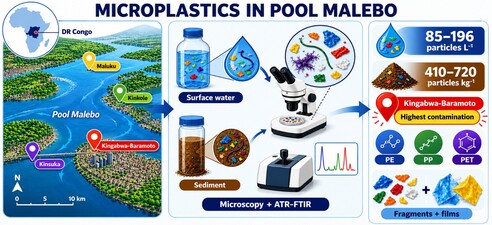
Data on microplastics in Central African inland waters remain limited. This study assesses contamination in the surface waters and surficial sediments of four Pool Malebo sites: Maluku, Kinkole, Kingabwa-Baramoto, and Kinsuka, Democratic Republic of the Congo. Sampling was conducted in June 2024, with three independent replicates per site. Water samples were vacuum-filtered, and sediments underwent KOH digestion followed by vacuum filtration. Suspected particles were characterized by stereomicroscopy, and selected particles were identified by attenuated total reflectance Fourier-transform infrared spectroscopy (ATR-FTIR). Mean abundance ranged from 85 to 196 particles L⁻¹ in water and from 410 to 720 particles kg⁻¹ of dry sediment. Kingabwa-Baramoto showed the highest mean abundances, with significant differences among sites in both compartments (p < 0.001). Fragments and films were dominant. The main polymers identified were polyethylene (PE), polypropylene (PP), and polyethylene terephthalate (PET). These findings provide baseline data for Pool Malebo and highlight the need for harmonized, repeated monitoring of microplastic pollution in the Congo River system.
Downloads
References
Hidalgo-Ruz, V., Gutow, L., Thompson, R. C., & Thiel, M., 2012, Microplastics in the marine environment: A review. Environmental Science & Technology 46(6), 3060–3075. https://doi.org/10.1021/es2031505
Lu, H. C., Ziajahromi, S., Neale, P. A., & Leusch, F. D. L., 2021, A systematic review of freshwater microplastics in water and sediments: Recommendations for harmonisation to enhance future study comparisons. Science of the Total Environment 781, 146693. https://doi.org/10.1016/j.scitotenv.2021.146693
Yakubu, S., Miao, B., Hou, M., & Zhao, Y., 2024, A review of the ecotoxicological status of microplastic pollution in African freshwater systems. Science of the Total Environment 946, 174092. https://doi.org/10.1016/j.scitotenv.2024.174092
Nyaga, M. P., Shabaka, S., Oh, S., Osman, D. M., Yuan, W., Zhang, W., & Yang, Y., 2024, Microplastics in aquatic ecosystems of Africa: A comprehensive review and meta-analysis. Environmental Research 248, 118307. https://doi.org/10.1016/j.envres.2024.118307
Masua Tchomba, B., Kaki Ngisila, B., Musibono Eyul’Anki, D., Pwema Kiamfu, V., & Kayembe Sungula, J., 2024, Plastic pollution of Kinshasa rivers: Highlighting microplastic contamination of the Malebo Pool hydrosystem (Congo River) in Kinshasa (DR Congo) and risk to the health of tourists. International Journal of Innovation and Scientific Research 76(1), 93–126. http://www.issr-journals.org/links/papers.php?journal=ijisr&application=pdf&article=IJISR-24-289-12
Primpke, S., Christiansen, S. H., Cowger, W., De Frond, H., Deshpande, A., Fischer, M., Holland, E. B., Meyns, M., O'Donnell, B. A., Ossmann, B. E., Pittroff, M., Sarau, G., Scholz-Böttcher, B. M., & Wiggin, K. J., 2020, Critical assessment of analytical methods for the harmonized and cost-efficient analysis of microplastics. Applied Spectroscopy 74(9), 1012–1047. https://doi.org/10.1177/0003702820921465
Lusher, A. L., & Hernandez-Milian, G., 2018, Microplastic extraction from marine vertebrate digestive tracts, regurgitates and scats: A protocol for researchers from all experience levels. Bio-protocol 8(22), e3087. https://doi.org/10.21769/BioProtoc.3087
Fan, C., Huang, Y.-Z., Lin, J.-N., & Li, J., 2021, Microplastic constituent identification from admixtures by Fourier-transform infrared (FTIR) spectroscopy: The use of polyethylene terephthalate (PET), polyethylene (PE), polypropylene (PP), polyvinyl chloride (PVC) and nylon (NY) as the model constituents. Environmental Technology & Innovation 23, 101798. https://doi.org/10.1016/j.eti.2021.101798
Lambert, S., Sinclair, C.J., Boxall, A.B.A., 2014, Occurrence, degradation, and effects of polymer-based materials in the environment. Reviews of Environmental Contamination and Toxicology 227, 1–53. https://doi.org/10.1007/978-3-319-01327-5_1.
Gulmine, J. V., Janissek, P. R., Heise, H. M., & Akcelrud, L., 2002, Polyethylene characterization by FTIR. Polymer Testing 21(5), 557–563. https://doi.org/10.1016/S0142-9418(01)00124-6
Mecozzi, M., & Nisini, L., 2019, The differentiation of biodegradable and non-biodegradable polyethylene terephthalate (PET) samples by FTIR spectroscopy: A potential support for the structural differentiation of PET in environmental analysis. Infrared Physics & Technology 101, 119-126. https://doi.org/10.1016/j.infrared.2019.06.008
Zhu, X., Yan, D., & Fang, Y., 2001, In situ FTIR spectroscopic study of the conformational change of isotactic polypropylene during the crystallization process. The Journal of Physical Chemistry B 105(50), 12461–12463. https://doi.org/10.1021/jp012165f
Zea, Cobos, A.G., Amón, J., León, E., Caballero, P., 2024, Standardization of FTIR-based methodologies for microplastics dtection in drinking water: A meta-analysis indeed and practical approach. Water 16(22), 3170. https://doi.org/10.3390/w16223170
Peng, J., Wang, J., & Cai, L., 2017, Current understanding of microplastics in the environment: Occurrence, fate, risks, and what we should do. Integrated Environmental Assessment and Management 13(3), 476–482. https://doi.org/10.1002/ieam.1912
Vandermeersch, G., Van Cauwenberghe, L., Janssen, C. R., Marques, A., Granby, K., Fait, G., Kotterman, M. J. J., Diogène, J., Bekaert, K., Robbens, J., & Devriese, L., 2015, A critical view on microplastic quantification in aquatic organisms. Environmental Research 143, 46–55. https://doi.org/10.1016/j.envres.2015.07.016
Campanale, C., Massarelli, C., Savino, I., Locaputo, V., & Uricchio, V. F., 2020, A Detailed Review Study on Potential Effects of Microplastics and Additives of Concern on Human Health. International Journal of Environmental Research and Public Health 17(4), 1212. https://doi.org/10.3390/ijerph17041212
Rochman, C. M., Browne, M. A., Halpern, B. S., Hentschel, B. T., Hoh, E., Karapanagioti, H. K., Rios-Mendoza, L. M., Takada, H., Teh, S., & Thompson, R. C., 2013, Policy: Classify plastic waste as hazardous. Nature 494(7436), 169–171. https://doi.org/10.1038/494169a
Downloads
Additional Files
Published
How to Cite
Issue
Section
License
Copyright (c) 2026 Nathan Manimesia Kayemba, Cédric Manianga K, Christian Matamba Mpingija, Junior Omba Ombetshu, Clovis Ndege Simisi, Jean-Paul Koto-Te-Nyiwa Ngbolua, Crispin Mulaji Kyela

This work is licensed under a Creative Commons Attribution-NonCommercial 4.0 International License.
This work is licensed under a Creative Commons Attribution-NonCommercial 4.0 International License (CC BY-NC 4.0).
Readers may copy, distribute, and adapt the work for non-commercial purposes, provided the original author and source are credited.
For full licence details, please visit https://creativecommons.org/licenses/by-nc/4.0/.


