
Factors Governing Biofilm Formation in Drinking Water Networks: A General Survey
DOI:
https://doi.org/10.63095/NBSEH.26.117702Keywords:
Biofilm, Drinking water, Disinfection, FactorsAbstract
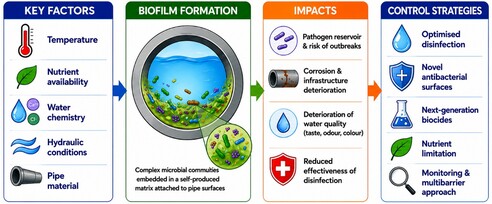
The drinking water distribution system (DWDS) is often threatened by the dangerous threat of biofilms as these intricate microbial consortia aggressively colonize pipe surfaces and act as reservoirs for pathogens which accelerate the infrastructure decay and degrade the organoleptic quality. Their resistance to conventional disinfection which includes chlorine, and their powerful regenerative capacity make eradication strategies ineffective. Environmental variables that govern biofilm proliferation include temperature, nutrient availability, water chemistry, and hydrodynamics, as well as the pipe material. The safeguarding of the water quality needs to be transformed by integrated and multi-barrier strategies. This necessitates also the implementation of advanced solutions like novel antibacterial surfaces, next-generation biocides, and stringent nutrient limitation to interrupt the resilience of biofilm and to protect public health.
Downloads
References
Zhang, Y., Yang, Z., Wang, Y., Bian, Y., Xu, R., & He, X., 2025, Community structure and influencing factors of biofilms in stagnant water of premise plumbing system. Journal of Water Process Engineering 75, 107958. https://doi.org/10.1016/j.jwpe.2025.107958
Moreno, Y., Moreno-Mesonero, L., Soler, P., Zornoza, A., & Soriano, A., 2024, Influence of drinking water biofilm microbiome on water quality: Insights from a real-scale distribution system. Science of The Total Environment 921, 171086. https://doi.org/10.1016/j.scitotenv.2024.171086
Hemdan, BA., El-Taweel, GE., Goswami, P., Pant, D., & Sevda, S., 2021, The role of biofilm in the development and dissemination of ubiquitous pathogens in drinking water distribution systems: an overview of surveillance, outbreaks, and prevention. World Journal of Microbiology Biotechnology 37, 36. https://doi.org/10.1007/s11274-021-03008-3
Oliveira, I. M., Gomes, I. B., Simões, L. C., & Simões, M., 2024, A review of research advances on disinfection strategies for biofilm control in drinking water distribution systems. Water Research 253, 121273. https://doi.org/10.1016/j.watres.2024.121273
Lin, W., Zhao, K., Wu, Q., Xu, F., Cui, L., Lin, H., Ye, C., & Yu, X., 2025, Biofilms on pipelines shape the microbiome and antibiotic resistome in drinking water. Water Research 274, 123136. https://doi.org/10.1016/j.watres.2025.123136
Meradji, S., Basher, N.S., Sassi, A., Ibrahim, N.A., Idres, T., & Touati, A., 2025, The role of water as a reservoir for antibiotic-resistant bacteria. Antibiotics 14, 763. https://doi.org/10.3390/antibiotics14080763
Gleason, J.A., & Cohn, P.D., 2022, A review of legionnaires’ disease and public water systems–Scientific considerations, uncertainties and recommendations. International Journal of Hygiene Environmental Health 240, 113906. https://doi.org/10.1016/j.ijheh.2021.113906
Erdei-Tombor, P., Kiskó, G., & Taczman-Brückner A, 2024, Biofilm formation in water distribution systems. Processes 12, 280. https://doi.org/10.3390/pr12020280
Neu, L., Proctor, C.R., Walser, J.-C., & Hammes, F., 2019, Small-scale heterogeneity in drinking water biofilms. Frontiers in microbiology 10, 2446. https://doi.org/10.3389/fmicb.2019.02446
Guo, L., Xiao, X., Chabi, K., Zhang, Y., Li, J., Yao, S., & Yu, X., 2024, Occurrence of viable but non-culturable (VBNC) pathogenic bacteria in tap water of public places. Frontiers of Environmental Science Engineering 18, 35. https://doi.org/10.1007/s11783-024-1795-4
Timoncini, A., Lorenzetti, L., Turner, R.J., McGibbon, A., Martini, C., Cofini, E., Bernardi, E., & Chiavari, C., 2024, Inhibition of Pseudomonas aeruginosa biofilm formation on copper-based thin foils. PLoS One 19, e0314684. https://doi.org/10.1371/journal.pone.0314684
Alhoshy, M.A., Samhan, F.A., El-Gendy AS., & Razek, T.M., 2025, Impact of Biofilm in Distribution Water Systems on Water Characteristics and Attempts for Treatment. Water, Air, Soil Pollution 236, 463. https://doi.org/10.1007/s11270-025-08077-w
Leena Catherine, A. F., Priyanka, V., Nandhini, B., Jagannathan, S., & Suresh, B., 2026, Microbiologically influenced corrosion dynamics and technological innovations in monitoring and control. Journal of Microbiological Methods 243, 107432. https://doi.org/10.1016/j.mimet.2026.107432
Planko, T., Fitzek, H., Eichinger, S., Rattenberger, J., Koraimann, G., Schröttner, H., 2026, Microbiologically influenced corrosion (MIC) of steel–a study using correlative SEM, EDXS and Raman microscopy. Materials Chemistry Physics 355, 132175. https://doi.org/10.1016/j.matchemphys.2026.132175
Guo, H., Wang, R., Jiang, M., Tian, Y., Jin, Y., Zhao, W., Wang, C., & Yin, J., 2025, Cement-mortar lining failure and metal release caused by electrochemical corrosion of ductile iron pipes in drinking water distribution systems. Journal of Environmental Sciences 152, 488-502. https://doi.org/10.1016/j.jes.2024.06.003
Zhou, X., Zhang, K., Zhang, T., Li, C.,& Mao, X., 2017, An ignored and potential source of taste and odor (T&O) issues—biofilms in drinking water distribution system (DWDS). Applied Microbiology Biotechnology 101, 3537-3550. https://doi.org/10.1007/s00253-017-8223-7
Zlatanović, L., van der Hoek, J.P., & Vreeburg, J., 2017, An experimental study on the influence of water stagnation and temperature change on water quality in a full-scale domestic drinking water system. Water Research 123, 761-772. https://doi.org/10.1016/j.watres.2017.07.019
Healy, H.G., Ehde, A., Bartholow, A., Kantor, R.S., & Nelson, K.L., 2024, Responses of drinking water bulk and biofilm microbiota to elevated water age in bench-scale simulated distribution systems. npj Biofilms Microbiomes 10, 7. https://doi.org/10.1038/s41522-023-00473-6
Li, B., Feng, L., Chouari, R., Samoili, S., & Giannakis, S., 2025, Trace metals induce microbial risk and antimicrobial resistance in biofilm in drinking water. NPJ Clean Water 8, 8. https://doi.org/10.1038/s41545-025-00436-8
Siponen, S., Ikonen, J., Gomez-Alvarez, V., Hokajärvi, A.-M., Ruokolainen, M., Jayaprakash, B., Kolehmainen, M., Miettinen, I.T., Pitkänen, T., & Torvinen, E., 2025, Effect of pipe material and disinfectant on active bacterial communities in drinking water and biofilms. Journal of applied microbiology 136, lxaf004. https://doi.org/10.1093/jambio/lxaf004
Rahmatika, I., Kasuga, I., Kurisu, F., & Furumai, H., 2020, Impacts of organic matter migrating from pipe materials on microbial regrowth in drinking water. Journal of Water Environment Technology 18, 45-53. https://doi.org/10.2965/jwet.19-078
Liu, T., Xiu, J., Huang, X., Geng, B., Hu, L., & Bai, X., 2025, Material-driven microbiologically influenced corrosion mechanisms in drinking water distribution systems. Water Research 288, 124729. https://doi.org/10.1016/j.watres.2025.124729
Flemming, H.-C., van Hullebusch, E.D., Little, B.J., Neu, T.R., Nielsen, P.H., Seviour, T., Stoodley, P., Wingender, J., & Wuertz, S., 2025, Microbial extracellular polymeric substances in the environment, technology and medicine. Nature Reviews Microbiology 23, 87-105. https://doi.org/10.1038/s41579-024-01098-y
Desmond, P., Best, J.P., Morgenroth, E., & Derlon, N., 2018, Linking composition of extracellular polymeric substances (EPS) to the physical structure and hydraulic resistance of membrane biofilms. Water research 132, 211-221. https://doi.org/10.1016/j.watres.2017.12.058
Nisar, M.A., Hayward, C., Ross, K.E., Brown, M.H., Bentham, R., & Whiley, H., 2025, Efficacy of physical and chemical disinfection against clinically relevant free-living amoebae isolated from drinking water and plumbing biofilms. Frontiers in Microbiology 16, 1654984. https://doi.org/10.3389/fmicb.2025.1654984
Potgieter, S., Dai, Z., Havenga, M., Vosloo, S., Sigudu, M., Pinto, A., & Venter, S., 2021, Reproducible microbial community dynamics of two drinking water systems treating similar source waters. ACS ES&T Water 1, 1617-1627. https://doi.org/10.1101/678920
Abkar, L., Moghaddam, H.S., & Fowler, S.J., 2024, Microbial ecology of drinking water from source to tap. Science of The Total Environment 908, 168077. https://doi.org/10.1016/j.scitotenv.2023.168077
Guo, X., Qi, B., Fu, H., Zhang, P., Zhao, J., Ouyang, J., Mao, J., & Yuan, Y., 2026, The impact of chlorine-based disinfection on the corrosion behavior of cast iron pipes in water distribution systems. Engineering Failure Analysis 184, 110301. http://dx.doi.org/10.2139/ssrn.5476113
Oschmann, A.M., Konrat, K., Schaudinn, C., Sohl, G., Wagner, D., Lewin, A., & Arvand, M., 2025, Biofilm formation by the global outbreak strain of Mycobacterium chimaera results in significantly reduced efficacy of standard disinfectants. BMC microbiology 25, 738. https://doi.org/10.1186/s12866-025-04439-w
Li, Z., & Zhang, L., 2025, Temperature phase shift determines microbial community succession and assembly pattern in climate-stressed wastewater treatment plants. Bioresource Technology 442, 133723. https://doi.org/10.1016/j.biortech.2025.133723
Yao, M., Ren, A., Yang, X., Chen, L., Wang, X., van der Meer, W., van Loosdrecht, M.C., Liu, G., & Pabst, M., 2025, Unveiling the influence of heating temperature on biofilm formation in shower hoses through multi-omics. Water Research 268, 122704. https://doi.org/10.1016/j.watres.2024.122704
Cazals, M., Bédard, E., Maldonado, J.F.G., & Prévost, M., 2025, What happens in your water system? Impact of materials, temperature, stagnation and chlorination on water quality and biofilm formation. Chemosphere 376, 144248. https://doi.org/10.1016/j.chemosphere.2025.144248
Elgoulli, M., Tankiouine, S., Aitlahbib, O., Zahir, H., ElLouali, M., & Latrache, H., 2020, Effect of water temperature on surfaces' physicochemical properties and adhesion of Pseudomonas aeruginosa in turbulence conditions. EurAsian Journal of BioSciences 14, 7245-7251.
Lamas, A., Fernandez-No, I., Miranda, J., Vázquez, B., Cepeda, A., & Franco, C., 2016, Biofilm formation and morphotypes of Salmonella enterica subsp. arizonae differs from those of other Salmonella enterica subspecies in isolates from poultry houses. Journal of Food Protection 79, 1127-1134. https://doi.org/10.4315/0362-028X.JFP-15-568
Chen, G., Fanouraki, G., Anandhi R.A., Winkelman, B.T., Winkelman, J.T., Waters, C.M., & Mukherjee, S., 2024, Combinatorial control of Pseudomonas aeruginosa biofilm development by quorum-sensing and nutrient-sensing regulators. Msystems 9, e00372-00324. https://doi.org/10.1128/msystems.00372-24
World Health Organization, 2024, Guidelines for drinking-water quality: Small water supplies. Geneva: World Health Organization. https://iris.who.int/server/api/core/bitstreams/4a3dc8a4-9f08-4d62-b7ec-96d70be6b177/content
Kilic, T., 2025, Factors affecting biofilm formation and the effects of these factors on bacteria. In Exploring Bacterial Biofilms. Edited by, IntechOpen. https://10.5772/intechopen.1008877
Qin, S., Chen, W., Lin, Y., Tan, S., Liang, S., Liu, H.,& Zhang, Q., 2025, Effect of hydraulic retention time on the nitrogen removal performance of pure biofilm rotating biological contactor system inoculated with heterotrophic nitrification-aerobic denitrification bacteria and its corresponding mechanism. Bioresource Technology 427, 132428. https://doi.org/10.1016/j.biortech.2025.132428
Tran, P., Lander, S.M., & Prindle, A., 2024, Active pH regulation facilitates Bacillus subtilis biofilm development in a minimally buffered environment. Mbio 15, e03387-03323. https://doi.org/10.1128/mbio.03387-23
Yanik, H.D., Mustak, H.K., & Sariçam İnce, S., 2025, Effects of environmental and genetic factors on biofilm formation of various Salmonella serotypes. Turkish Journal of Veterinary Animal Sciences 49, 70-75. https://doi.org/10.55730/1300-0128.4372
Zhang, W., Seminara, A., Suaris, M., Brenner, M.P., Weitz, D.A., & Angelini, T.E., 2014, Nutrient depletion in Bacillus subtilis biofilms triggers matrix production. New Journal of Physics 16, 015028. https://doi.org/10.1088/1367-2630/16/1/015028
Elgoulli, M., Aitlahbib, O., Tankiouine, S., Assaidi, A., Louali, M.E., Zahir, H., & Latrache, H., 2021a, The theoretical adhesion of Pseudomonas aeruginosa and Escherichia coli on some plumbing materials in presence of distilled water or tap water. Folia Microbiologica 66, 607-613. https://doi.org/10.1007/s12223-021-00868-y
Elgoulli, M., Zahir, H., Aitlahbib, O., Ellouali, M., Latrache, H., 2021b, Effect of chemical compounds in water on surface properties and adhesion capacity of Pseudomonas aeruginosa and Escherichia coli in turbulent conditions. Water SA 47, 430-436. https://doi.org/10.17159/wsa/2021.v47.i4.3859
Montoya-Pachongo, C., Douterelo, I., Noakes, C., Camargo-Valero, M.A., Sleigh, A., Escobar-Rivera, J.-C., & Torres-Lozada, P., 2018, Field assessment of bacterial communities and total trihalomethanes: Implications for drinking water networks. Science of the Total Environment 616, 345-354. https://doi.org/10.1016/j.scitotenv.2017.10.254
Chen, H., Zhang, S., Wang, H., Ma, X., Wang, M., Yu, P., & Shi, B., 2025, Co-selective effect of dissolved organic matter and chlorine on the bacterial community and their antibiotic resistance in biofilm of drinking water distribution pipes. Water Research 268, 122664. https://doi.org/10.1016/j.watres.2024.122664
Pang, X., Yang, Y., & Yuk, H., 2017, Biofilm formation and disinfectant resistance of Salmonella sp. in mono‐and dual‐species with Pseudomonas aeruginosa. Journal of Applied Microbiology 123, 651-660. https://doi.org/10.1111/jam.13521
Chen, L., Shi, H., Medema, G., van der Meer, W., & Liu, G., 2025, Long-term impacts of free chlorine and monochloramine on the development of drinking water biofilm. Water Research 281, 123566. https://doi.org/10.1016/j.watres.2025.123566
Elgoulli, M., Zahir, H., Ellouali, M., Latrache, H., 2024, Chlorination of Pseudomonas aeruginosa in potable water. International Journal of Environmental Health Research 6, 1-8. https://doi.org/10.1080/09603123.2024.2338891
Elgoulli, M., Zahir, H., Ellouali, M., & Latrache, H., 2023, Disruption of Pseudomonas aeruginosa Adherent Cells by NaCl and NaOCl in Drinking Water. Current Microbiology 80, 138. https://doi.org/10.1007/s00284-023-03241-z
Chen, J., Guo, Y., Lin, Y., Zhang, Y., Qian, Q., Zhang, X., Lin, P., Chen, C., & Xie, S., 2025, Fate, mobility and pathogenicity of antibiotic resistome in a full-scale drinking water treatment plant: Highlighting the chlorination risks. Journal of Environmental Management 390, 126425. https://doi.org/10.1016/j.jenvman.2025.126425
Rogers, J., 2024, Investigating and managing biofilm and material accumulation in chlorine and chloramine drinking water distribution systems. Edited by: University of Sheffield. https://etheses.whiterose.ac.uk/id/eprint/36209/
Zhao, W., Hou, Y., Wei, L., Wei, W., Zhang, K., Duan, H., & Ni, B.-J., 2025, Chlorination-induced spread of antibiotic resistance genes in drinking water systems. Water Research 274, 123092. https://doi.org/10.1016/j.watres.2025.123092
Tierra, G., Pavissich, J.P., Nerenberg, R., Xu, Z., & Alber, M.S., 2015, Multicomponent model of deformation and detachment of a biofilm under fluid flow. Journal of The Royal Society Interface 12, 20150045. https://doi.org/10.1098/rsif.2015.0045
Zeidan, M., & Ostfeld, A., 2022, Using hydraulic transients for biofilm detachment in water distribution systems: Approximated model. Journal of Water Resources Planning Management 148, 04022008. https://doi.org/10.1061/(ASCE)WR.1943-5452.0001539
Hope, J.A., Kleinteich, J., Gerbersdorf, S.U., 2025, Benthic biofilm structure and function under abrupt flow changes. PLoS One 20, e0327216. https://doi.org/10.1371/journal.pone.0327216
Bridges, E., Bircher, S., Cunningham, K., Vasam, V., Hando, J., & Garner, E., 2025, Divergent bacterial communities in water and sediment of chlorinated drinking water storage tanks. ACS Est Water 6, 217-227. https://doi.org/10.1021/acsestwater.5c00928
Learbuch, K., Smidt, H., Van Der Wielen, P., 2021, Influence of pipe materials on the microbial community in unchlorinated drinking water and biofilm. Water Research 194, 116922. https://doi.org/10.1016/j.watres.2021.116922
Xiu, J., Geng, B., Liu, M., Han, X., Zhang, D., & Bai, X., 2025, Biofilm induced microplastics and microbial metabolites release from Polypropylene Random pipes in drinking water distribution systems. Water Research 288, 124626. https://doi.org/10.1016/j.watres.2025.124626
Emelyanenko, A.M., Omran, F.S., Chernukha, M.Y., Avetisyan, L.R., Tselikina, E.G., Putsman, G.A., Zyryanov, S.K., Emelyanenko, K.A., Buglak, A.V., & Boinovich, L.B., 2025, Engineering wettability-controlled copper surfaces to mitigate airborne bacterial contamination in hospitals. Colloids Surfaces A: Physicochemical Engineering Aspects 719, 137085. https://doi.org/10.1016/j.colsurfa.2025.137085
Wang, J., Peipoch, M., Guo, X., & Kan, J., 2022, Convergence of biofilm successional trajectories initiated during contrasting seasons. Frontiers in Microbiology 13, 991816. https://doi.org/10.3389/fmicb.2022.991816
Huang, S., Jiang, F., Dong, Q., Yu, J., Fan, K., Wang, Z., Hao, S., & Qiao, Y., 2025, The impact of climate change induced extreme weather events on microbial dynamics and public health: an in-depth review on water quality and ecosystem resilience. Frontiers in Environmental Science 13, 1674490. https://doi.org/10.3389/fenvs.2025.1674490
Amador, C.I., Røder, H.L., Herschend, J., Neu, T.R., & Burmølle, M., 2025, Decoding the impact of interspecies interactions on biofilm matrix components. Biofilm 9, 100271. https://doi.org/10.1016/j.bioflm.2025.100271
Nithyanand, P., Boya, B.R., Lee, J.H., & Lee, J., 2025, Polymicrobial biofilms: Interkingdom interactions, resistance and therapeutic strategies. Microbial Biotechnology 18, 70218. https://doi.org/10.1111/1751-7915.70218
Wang, Y., Jiang, L., Zhou, F., Zhang, Y., Fine, R.D., Li, M., 2025, The hidden dancers in water: the symbiotic mystery of Legionella pneumophila and free-living amoebae. Frontiers in Microbiology 16, 1634806. https://doi.org/10.3389/fmicb.2025.1634806
Schroeter, S.A., Orme, A.M., Lehmann, K., Lehmann, R., Chaudhari, N.M., Küsel, K., Wang, H., Hildebrandt, A., Totsche, K.U., & Trumbore, S., 2025, Hydroclimatic extremes threaten groundwater quality and stability. Nature Communications 16, 720. https://doi.org/10.1038/s41467-025-55890-2
Fira-Mladinescu, C., Margan, M.-M., Margan, R., Ardelean, F., Sînmârghițan, A.I., Marincov, D., Tuță-Sas, I., Marin, I., Cîndrea, A.-C., & Bodea, D.-A., 2026, Meteorological influence on drinking water quality: microbial variability in groundwater wells and piped distribution networks from western romania. Microorganisms 14, 148. https://doi.org/10.3390/microorganisms14010148
Swinamer, R., Anderson, L.E., Redden, D., Bjorndahl, P., Campbell, J., Krkošek, W.H., & Gagnon, G.A., 2024, Climate-driven increases in source water natural organic matter: Implications for the sustainability of drinking water treatment. Environmental Science Technology 58, 11958-11969. https://doi.org/10.1021/acs.est.4c01894
Chen, L., Ma, M., Li, X., Yu, K., Zhi, C., Cheng, L., Ma, H., Wang, Z., & Qian, X., 2024, Effects of fresh groundwater and seawater mixing proportions and salt-freshwater displacement on coastal aquifer microbial communities. Water 16, 2078. https://doi.org/10.3390/w16152078
Manirakiza, B., Zhang, S., Addo, F.G., Yu, M., & Alklaf, S.A., 2024, Interactions between water quality and microbes in epiphytic biofilm and superficial sediment of lake in trophic agriculture area. Science of the Total Environment 912, 169321. https://doi.org/10.1016/j.scitotenv.2023.169321
Sumanasekera, S.,& Rajapakse, J., 2025, Turbidity as a barrier to water treatment: a review of current and emerging removal technologies, advantages and limitations. https://doi.org/110.20944/preprints202509.2551.v1
LeChevallier, M.W., 2019, Occurrence of culturable Legionella pneumophila in drinking water distribution systems. AWWA Water Science 1, e1139. https://doi.org/10.1002/aws2.1139
García-Ávila, F., Sánchez-Alvarracín, C., Cadme-Galabay, M., Conchado-Martínez, J., García-Mera, G., & Zhindón-Arévalo, C., 2020, Relationship between chlorine decay and temperature in the drinking water. MethodsX 7, 101002. https://doi.org/10.1016/j.mex.2020.101002
Wang, Y., Zhang, Z., Xia, M., Zhang, X., Lan, R., Wei, B., Liu, Y., Lu, Y., & Fan, G., 2025, Mechanism and risk control of chlorine-resistant bacteria in drinking water supply systems: A comprehensive bibliometric analysis. Water 17, 956. https://doi.org/10.3390/w17070956
Zhu, Z., Shan, L., Hu, F., Li, Z., Zhong, D., Yuan, Y., & Zhang, J., 2020, Biofilm formation potential and chlorine resistance of typical bacteria isolated from drinking water distribution systems. RSC advances 10, 31295-31304. https://doi.org/10.1039/d0ra04985a
Downloads
Additional Files
Published
How to Cite
Issue
Section
License
Copyright (c) 2026 Mourad Elgoulli, Ikhlas Hani Chennoufi, Soukaina Mitro, Hafida Zahir, Mostafa Ellouali, Hassan Latrache

This work is licensed under a Creative Commons Attribution-NonCommercial 4.0 International License.
This work is licensed under a Creative Commons Attribution-NonCommercial 4.0 International License (CC BY-NC 4.0).
Readers may copy, distribute, and adapt the work for non-commercial purposes, provided the original author and source are credited.
For full licence details, please visit https://creativecommons.org/licenses/by-nc/4.0/.


