
Nepalese Calamity of 2026: Manmade or Climate Driven
DOI:
https://doi.org/10.63095/NBSEH.26.557122Keywords:
Flash floods, Nepal, China, Glacier FailureAbstract
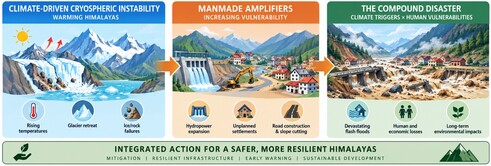
The flash floods of August 26, 2026, along the Nepal-Tibet border are one of the most devastating Himalayan disasters since the 2015 earthquake. Some believe that the event was driven by anthropogenic activities. Others attribute it to climate change. To have greater clarity of the primary cause and to draw lessons for the future, this paper examines the catalysts behind the disaster. Although the primary geological event may have been rooted in climate change, the catastrophic scale of downstream destruction seems to have been greatly amplified by manmade vulnerabilities. Unplanned development leading to high density of downstream settlements, unabated infrastructure activities in the seismically weak Himalayas, and proliferation of high-risk hydropower infrastructure in narrow valleys significantly multiplied the economic and human toll. Hence, the calamity cannot be categorized as purely natural or manmade but a compound one, where climate-induced cryospheric instability collided with systemic failures in climate-resilient engineering and transboundary early-warning systems. The study concludes with policy recommendations for transboundary disaster risk reduction in the warming Himalayas.
Downloads
References
Roohi, M., Dehghani, J., Irani, M., & Mina, P., 2025, A comprehensive review of flood damage in mountainous regions: challenges, solutions, and advanced management technologies. Discover Geoscience 3, 59. https://doi.org/10.1007/s44288-025-00145-2
Stoffel, M., Wyżga, B., & Marston, R. A., 2016, Floods in mountain environments: A synthesis, Geomorphology 272, 1-9, https://doi.org/10.1016/j.geomorph.2016.07.008
Al Jazeera, 2026, Nepal-China flood disaster: What’s the latest toll, how many are missing? Al Jazeera English, August 30. Available at https://www.aljazeera.com/news/2026/8/30/nepal-china-flood-disaster-whats-the-latest-toll-how-many-are-missing (accessed 04 September 2026).
Wong, T., 2026, Collapsed glacier likely caused devastating Nepal-Tibet flash flood. BBC News. August 28. Available at https://www.bbc.com/news/articles/cly464k252yo (accessed 04 September 2026).
Murtaza, M., 2026, When a mountain falls: How ice and rock triggered Nepal's catastrophic flood – and why climate change is raising the risks. The Conversation, August 29. Available at https://theconversation.com/when-a-mountain-falls-how-ice-and-rock-triggered-nepals-catastrophic-flood-and-why-climate-change-is-raising-the-risks-290779 (accessed 04 September 2026).
The Guardian, 2026, Nepal-Tibet flash flood: what we know so far, The Guardian, August 28. Available at https://www.theguardian.com/world/2026/aug/27/nepal-tibet-flash-floods-what-we-know-so-far-flooding (accessed 04 September 2026).
DTE, 2026, Journalist group in Nepal blames Chinese construction activities on Tibetan border for triggering Rasuwa flash flood, Down To Earth, August 26. Available at https://www.downtoearth.org.in/natural-disasters/journalist-group-in-nepal-blames-chinese-construction-activities-on-tibetan-border-for-triggering-rasuwa-flash-flood (accessed 04 September 2026).
USGS, 2026, 2026 Nepal Debris Avalanche and Flash Flood, U.S. Geological Survey, August 27. Available at https://www.usgs.gov/programs/landslide-hazards/science/2026-nepal-debris-avalanche-and-flash-flood (accessed 04 September 2026).
UNCDP, 2024, Nepal graduation status and Smooth Transition Strategy framework, UN Portal for Least Developed Countries, Available at https://www.un.org/ldcportal/content/nepal-graduation-status (accessed 04 September 2026).
Dahal, K., & Timalsina, K. P., 2017, New Towns Development: A Wave of the Future Planning Practices in Nepal. Tribhuvan University Journal 31(1-2), 139-152. https://doi.org/10.3126/tuj.v31i1-2.25346
World Bank, 2020, *Nepal - Strategic Road Connectivity and Trade Improvement Project: Environment and Social Impact Assessment (English). (Washington, D.C.: World Bank Group). Available at http://documents.worldbank.org/curated/en/122051582322813326 (accessed 04 September 2026).
ADB, 2023, Roads Enhance Connectivity and Create Opportunities in Isolated Hills in Nepal, Asian Development Bank, March 17. Available at https://www.adb.org/results/roads-enhance-connectivity-create-opportunities-isolated-hills-nepal (accessed 04 September 2026).
Manan Sharma, S., & Rawat Sharma, 2025, Why Hydropower Projects in Nepal Get Delayed: Understanding the Bottlenecks in Development, International Journal Of Engineering Research & Technology (IJERT) 14(05). https://doi.org/10.5281/zenodo.18106575
Pangeni, R., 2026, Nepal’s flood disaster puts its hydropower-first strategy, exports to the test. Mongabay Conservation news https://doi.org/10.66709/news-328384
Gautam, R., Shakya, A., & Kadariya, S., 2025, The Realities of Government Construction Projects in Nepal: Systemic Inefficiencies and Challenges. Journal of Himalaya College of Engineering 2(1), 88-96. https://doi.org/10.3126/jhcoe.v2i1.91581
Bista, I., 2022, Issues with Development Projects in Nepal: A Case Study of the Development Projects in Nepal and its Issues Using the Agent Based Approach (ABA). Systems Thinking 2(1), 1-20. https://doi.org/10.54120/jost.2025-0066IB
Dhakal, B., 2026, Nepal’s National Pride Projects: Progress, Promise and Persistent Hurdles, Nepal News, April 05. Available at https://english.nepalnews.com/s/business/nepals-national-pride-projects-progress-promise-and-persistent-hurdles/ (accessed 04 September 2026).
Yadav, P., & Adhikari, R., 2026, Connecting Margins to the Mainstream: Road Construction by the Nepali Army as a Catalyst for National unity, Unity Journal 7, 189-216. https://doi/org/10.3126/unityj.v7i1.90445
Shah, R., Mishra, S., Neumann, A., Adhikary, B., & Gurung, S., 2026, Electricity policies and market dynamics in Nepal: Implications for renewable integration and regional trade, Energy Reports 16, 109507,https://doi.org/10.1016/j.egyr.2026.109507
Bajracharya, S. R., Maharjan, S. B., Shrestha, F., Bajracharya, O. R., & Baidya, S., 2014, Glacier Status in Nepal and Decadal Change from 1980 to 2010 Based on Landsat Data. International Centre for Integrated Mountain Development (ICIMOD).
Maharjan, S. B., & Sherpa, T. C., 2026, Changing dynamics of glaciers in the Hindu Kush Himalayan region from 1990 to 2020, International Centre for Integrated Mountain Development (ICIMOD). https://doi.org/10.53055/ICIMOD.1122
Azam, M. F., 2026, HKH Glacier Outlook 2026: Understanding Change Through 50 Years of Field Observation. International Centre for Integrated Mountain Development (ICIMOD). https://doi.org/10.53055/ICIMOD.1123
Wester, P., Mishra, A., Mukherji, A., & Shrestha, A. B. (Eds.), 2019, The Hindu Kush Himalaya Assessment: Mountains, Climate Change, Sustainability and People. Springer Nature/ICIMOD, Switzerland IPCC, 2023, Climate Change 2023: Synthesis Report. Contribution of Working Groups I, II and III to the Sixth Assessment Report of the Intergovernmental Panel on Climate Change. IPCC. Available at https://www.ipcc.ch/report/ar6/syr/downloads/report/IPCC_AR6_SYR_FullVolume.pdf (accessed 04 September 2026).
Shrestha, A. B., Wake, C. P., Mayewski, P. A., & Dibb, J. E., 1999, Maximum temperature trends in the Himalaya and its vicinity: An analysis based on temperature records from Nepal for the period 1977–1994. Journal of Climate 12(9), 2775–2786. https://doi.org/10.1175/1520-0442(1999)012%3C2775:MTTITH%3E2.0.CO;2
Faillettaz, J., Funk, M., & Vincent, C., 2015, Avalanching glacier instabilities: Review on processes and early warning perspectives, Reviews of Geophysics 53, 203–224, https://doi.org/10.1002/2014RG000466
Kääb, A., Jacquemart, M., Gilbert, A., Leinss, S., Girod, L., Huggel, C., Falaschi, D., Ugalde, F., Petrakov, D., Chernomorets, S., Dokukin, M., Paul, F., Gascoin, S., Berthier, E., & Kargel, J. S., 2021, Sudden glacier collapses: A neglected hazard. The Cryosphere 15(4), 1933–1946. https://doi.org/10.5194/tc-15-1751-2021
Instagram, 2026, Earthpulase111, August 28. Available at https://www.instagram.com/p/DcjFkmBhVJi/ (accessed 04 September 2026).
Kafle, S. K., 2017, Disaster Early Warning Systems in Nepal: Institutional and Operational Frameworks. Journal of Geography & Natural Disasters 7(1), 196. https://doi.org/10.4172/2167-0587.1000196
Mcdermott, J., 2026, Satellite images show bedrock and glacier collapsed on Nepal-China border, then rivers flooded, AP News, August 28. Available at https://apnews.com/article/climate-change-nepal-tibet-glacier-collapse-floods-b3eda9410f9941f69add384944047bc3 (accessed 04 September 2026).
Science Media Centre, 2026, Expert reaction to flash floods in Nepal-Tibet, Science Media Centre, August 28. Available at https://www.sciencemediacentre.org/expert-reaction-to-flash-floods-in-nepal/ (accessed 04 September 2026).
Fan, X., Yunus, A. P., Yang, Y.-H., Subramanian, S. S., Zou, C., Dai, L., Dou, X., Narayana, A. C., Avtar, R., Xu, Q., & Huang, R., 2022, Imminent threat of rock-ice avalanches in High Mountain Asia, Science of The Total Environment 836, 155380, https://doi.org/10.1016/j.scitotenv.2022.155380
EBSCO, n.d, Avalanches, Research Starter Available at https://www.ebsco.com/research-starters/earth-and-atmospheric-sciences/avalanches (accessed 04 September 2026).
Ramanathan, K. & Vasudevan, N., 2021, Anthropogenic causes of landslides and their implications for monitoring, vEGU21, the 23rd EGU General Assembly, held online 19-30 April, 2021. https://doi.org/10.5194/egusphere-egu21-6933
Gurung, N., 2019, Natural Disasters Versus Anthropogenic Activities in Nepal Himalayas: Case Study from Ghatte Khola , Myagdi, Technical Journal 1(1), 65–70. https://doi.org/10.3126/tj.v1i1.27593
Yang, C., 2026, Unstable Tibetan Plateau risks cascading disasters as glacier losses mount in Nepal, China, South China Morning Post,
September 03. Available at https://www.scmp.com/news/china/article/3366180/unstable-tibetan-plateau-risks-cascading-disasters-glacier-losses-mount-nepal-china (accessed 04 September 2026).
Tong, Z., 2026, China and Nepal built an early warning system for melting glaciers in Himalayas. Does it work?, South China Morning Post, August 27. Available at https://www.scmp.com/news/china/science/article/3365488/china-and-nepal-built-early-warning-system-melting-glaciers-himalayas-does-it-work (accessed 04 September 2026).
Augustin, J., 2021, China’s building spree in Nepal casts shadow over Himalayan ecosystem, Mongabay Conservation news, December 31. Available at https://doi.org/10.66709/news-251342
Li, S., Li, C., Li, Z., Li, L., & Wang, W., 2025, Ice Avalanche-Triggered Glacier Lake Outburst Flood: Hazard Assessment at Jiongpuco, Southeastern Tibet, Water 17(14), 2102. https://doi.org/10.3390/w17142102
Tian, X., Yao, X., & Zhou, Z., 2025, Distribution patterns and risk assessment of potential ice avalanches and glacier lake outburst floods in southeastern Tibetan Plateau, Ecological Indicators 179, 114217, https://doi.org/10.1016/j.ecolind.2025.114217
Hawkins, A., 2026, Chinese control of information hampers assessment of Tibet flood damage, The Guardian, August 28. Available at https://www.theguardian.com/world/2026/aug/28/chinese-controls-information-hamper-assessment-tibet-flood-damage (accessed 04 September 2026).
Chellaney, B., 2026, Nepal-Tibet floods expose dangers of China's Himalayan gamble, Nikkei Asia, August 28. Available at https://asia.nikkei.com/opinion/nepal-tibet-floods-expose-dangers-of-china-s-himalayan-gamble (accessed 04 September 2026).
He, M., & Wang, L., 2026, Engineering challenges of deep-buried tunneling in the Alps and Himalayas, Rock Mechanics Bulletin 5(3), 100283, https://doi.org/10.1016/j.rockmb.2025.100283
Wei, S. T., 2026, Seven minutes to disaster: How climate change exposed a Himalayan blind spot, Think China, August 31. Available at https://www.thinkchina.sg/society/seven-minutes-disaster-how-climate-change-exposed-himalayan-blind-spot (accessed 04 September 2026).
Bai, Y., Li, D., Wangchuk, S., Kettner, A., Zhao, Y., Deng, R., Liu, Y., Xiao, C., Ni, J., & Cui, P., 2025, Flood complexity and rising exposure risk in High Mountain Asia under climate change, Science Bulletin 70(10), 1601-1604. https://doi.org/10.1016/j.scib.2025.01.055
Ran, Y., Cheng, G., Dong, Y., Hjort, J., Lovecraft, A.L., Kang, S., Tan, M. & Li, X., 2022, Permafrost degradation increases risk and large future costs of infrastructure on the Third Pole, Communications Earth & Environment 3, 238. https://doi.org/10.1038/s43247-022-00568-6
Chen, F., 2026, China is building a vast ‘national ring road’ circling the country’s borderlands, South China Morning Post, August 23. Available at https://www.scmp.com/economy/china-economy/article/3364884/china-building-vast-national-ring-road-circling-countrys-borderlands (accessed 04 September 2026).
Clarke, B., Zachariah, M., Davies, B., Hock, R., Immerzeel, W., Jha, R. & Robinson, T.R., 2026, Rapid warming in the Himalaya exacerbates geohazard cascades beyond adaptation limits, WWA Scientific Report No. 92, World Weather Attribution. https://doi.org/10.25560/136420
Ewe, K., & Khadka, N. S., 2026, Nepal to use new flood study to claim millions from UN climate disaster fund, BBC, September 17. Available at https://www.bbc.com/news/articles/cmlyrzve5pwzo (accessed 18 September 2026).
Ritchie, H. & Rosado, P., 2025, CO₂ and Greenhouse Gas Emissions, OurWorldinData.org. Available at https://ourworldindata.org/profile/co2/Nepal (accessed 18 September 2026).
Arasu, S., 2026, Climate change made deadly Nepal glacier and rock collapse more likely, according to analysis, Independent, September 17. Available at https://www.independent.co.uk/news/himalayan-nepal-india-bengaluru-imperial-college-london-b3051593.html (accessed 18 September 2026).
Agarwala, N. & Polinov, S., 2021, Curtailing Anthropogenic Carbon Dioxide to Meet the Targets of the Paris Agreement using Technology Support Mechanisms, Journal of Human-centricResearch in Humanities and Social Sciences 2(1), 1-24. http://dx.doi.org/10.21742/jhrhss.2021.2.1.01
Gayle, D., 2026. Climate crisis probably weakened glacier that caused devastating Nepal-Tibet floods, first study finds, The Guardian, September 17. Available at https://www.theguardian.com/science/2026/sep/17/climate-crisis-likely-behind-deadly-nepal-tibet-floods (accessed 18 September 2026).
Downloads
Additional Files
Published
How to Cite
Issue
Section
License
Copyright (c) 2026 Captain (Dr.) Nitin Agarwala

This work is licensed under a Creative Commons Attribution-NonCommercial 4.0 International License.
This work is licensed under a Creative Commons Attribution-NonCommercial 4.0 International License (CC BY-NC 4.0).
Readers may copy, distribute, and adapt the work for non-commercial purposes, provided the original author and source are credited.
For full licence details, please visit https://creativecommons.org/licenses/by-nc/4.0/.


