
Microalgae-Based Bioremediation of Microplastic-Contaminated Industrial Wastewater: Mechanisms and Challenges
DOI:
https://doi.org/10.63095/NBSEH.26.441608Keywords:
Microplastic removal, Microalgae, Wastewater treatment, BiodegradationAbstract
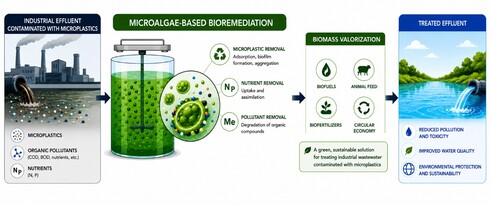
Microalgae-based bioremediation presents a promising eco-friendly approach for removing microplastics (MPs) from industrial effluents. This review summarizes the current understanding on this subject. The article begins by describing the characteristics and origins of MPs in industrial discharges. It then reviews documented mechanisms of microalgae–MP interactions, including adsorption/biosorption, bioflocculation, accumulation, and partial degradation. Important environmental and operational factors that influence treatment efficiency—such as MP size and charge, algal species, and culture conditions—are analysed. Additionally, the article discusses analytical methods necessary for MP characterization and monitoring performance. Microalgae-based methods are contrasted with traditional physical and chemical processes, highlighting the potential value of the processed biomass (such as bioenergy and biofertilizers) to showcase a circular bioeconomy approach. The review concludes by pinpointing key research gaps and offering recommendations for standardizing experimental procedures and encouraging the adoption of microalgal systems within sustainable wastewater treatment strategies.
Downloads
References
Hadiyanto, H., Khoironi, A., Dianratri, I., Joelyna, F. A., Christwardana, M., Sabhira, A. I., & Baihaqi, R. A., 2025, Microplastic removal in aquatic systems using extracellular polymeric substances (EPS) of microalgae. Sustainable Environment 11(1). https://doi.org/10.1080/27658511.2025.2454756
Lotfigolsefidi, F., Davoudi, M., Sarkhosh, M., & Bonyadi, Z., 2025, Removal of microplastics by algal biomass from aqueous solutions: performance, optimization, and modeling. Scientific Reports 15(1), 501. https://doi.org/10.1038/s41598-024-84114-8
Abomohra, A., & Hanelt, D., 2022, Recent Advances in Micro-/Nanoplastic (MNPs) Removal by Microalgae and Possible Integrated Routes of Energy Recovery. Microorganisms 10(12), 2400. https://doi.org/10.3390/microorganisms10122400
Paiva, A. L. P., Da Fonseca Silva, D. G., & Couto, E., 2021, Recycling of landfill leachate nutrients from microalgae and potential applications for biomass valorization. Journal of Environmental Chemical Engineering 9(5), 105952. https://doi.org/10.1016/j.jece.2021.105952
Hadian-Ghazvini, S., Hooriabad Saboor, F., & Safaee Ardekani, L., 2022, Bioremediation techniques for microplastics removal. In M. Sillanpää, A. Khadir, & S. S. Muthu (Eds.), Microplastics pollution in aquatic media (Environmental Footprints and Eco-design of Products and Processes). (Singapore : Springer). https://doi.org/10.1007/978-981-16-8440-1_15
Lusher, A. L., Bråte, I. L. N., Munno, K., Hurley, R. R., & Welden, N. A. 2020, Is It or Isn’t It: The Importance of Visual Classification in Microplastic Characterization. Applied Spectroscopy 74(9), 1139 1153. https://doi.org/10.1177/0003702820930733
Soliz, D. L., González, G. P., Muñoz-Arnanz, J., Bravo-Yagüe, J. C., Hernando, P. F., & Martínez, R. M. G., 2024, Identification and morphological characterization of different types of plastic microparticles. Heliyon 10(11), e30749. https://doi.org/10.1016/j.heliyon.2024.e30749
Joelyna, F. A., Hadiyanto, H., Khoironi, A., Sudarno, S., Safaat, J. A., & Pratama, W. D., 2024, The utilization of microalgae Chlorella vulgaris for microplastic bioremediation in aquatic systems and Aspergillus niger as a bioflocculant for harvesting. SSRN. https://doi.org/10.2139/ssrn.5017700
Abed, S. A., Alasady, R. K. A., & Jazie, A. A., 2021, Microplastics effect on the physicochemical parameters and interaction with spirulina platensis microalgae in Al-Dalmaj Marsh, Iraq. Materials Today Proceedings 42, 2251 2258. https://doi.org/10.1016/j.matpr.2020.12.312
Gong, X., Wang, Y., Huang, D., & Zhang, J., 2022, Effects of microplastics of different sizes on the Chlorella vulgaris - Ganoderma lucidum co-pellets formation processes. The Science of the Total Environment 820, 153266. https://doi.org/10.1016/j.scitotenv.2022.153266
Magalhães, S., Alves, L., Romano, A., Medronho, B., & Da Graça Rasteiro, M., 2022, Extraction and Characterization of Microplastics from Portuguese Industrial Effluents. Polymers 14(14), 2902. https://doi.org/10.3390/polym14142902
Cubas, A. L. V., Bianchet, R. T., Reis, I. M. A. S. D., & Gouveia, I. C., 2022, Plastics and Microplastic in the Cosmetic Industry: Aggregating Sustainable Actions Aimed at Alignment and Interaction with UN Sustainable Development Goals. Polymers 14(21), 4576. https://doi.org/10.3390/polym14214576
Liu, S., Hua, J., Zhang, Y., Gao, Y., Han, X., Liu, Y., Daigger, G. T., Li, Q., Guo, N., Song, Z., Zhang, P., Zhang, X., & Song, G., 2026, A critical review on microalgae-driven wastewater treatment: Dual focus on high-value bioproducts recovery and emerging contaminants removal. Journal of Environmental Sciences. Advance online publication. https://doi.org/10.1016/j.jes.2026.02.025
Ugya, A. Y., Meguellati, K., Aliyu, A. D., Abba, A., & Musa, M. A., 2022, Microplastic stress induce bioresource production and response in microalgae: a concise review. Environmental Pollutants and Bioavailability 34(1), 51 60. https://doi.org/10.1080/26395940.2022.2033138
Barari, F., Gabrabad, M. E., & Bonyadi, Z., 2024, Recent progress on the toxic effects of microplastics on Chlorella sp. in aquatic environments. Heliyon 10(12), e32881. https://doi.org/10.1016/j.heliyon.2024.e32881
Li, L., Yu, J., Ma, Y., Tan, H., Tan, F., Chai, Y., & Zhang, H., 2025, Microplastic-enhanced chromium toxicity in Scenedesmus obliquus : Synergistic effects on algal growth and biochemical responses. Ecotoxicology and Environmental Safety 291, 117813. https://doi.org/10.1016/j.ecoenv.2025.117813
Su, Y., Gao, L., Xu, E. G., Peng, L., Diao, X., Zhang, Y., & Bao, R., 2024, When microplastics meet microalgae: Unveiling the dynamic formation of aggregates and their impact on toxicity and environmental health. Water Research 273, 123008. https://doi.org/10.1016/j.watres.2024.123008
Charef, I., Fathi, A., Ozi, F. Z., Asbai, Z., Radi Benjelloun, G., Waddi, K., Bahlaouan, B., El Antri, S., & Boutaleb, N., 2024, The use of mixed biomass alga-fungi in mutualistic relationship and natural marine-origin carrier in MBBR reactor for an ecological treatment of effluents from fish processing industry in Morocco. Desalination and Water Treatment, 317, 100020. https://doi.org/10.1016/j.dwt.2024.100020
Barone, G. D., Rodríguez-Seijo, A., Parati, M., Johnston, B., Erdem, E., Cernava, T., Zhu, Z., Liu, X., Axmann, I. M., Lindblad, P., & Radecka, I., 2024, Harnessing photosynthetic microorganisms for enhanced bioremediation of microplastics : A comprehensive review. Environmental Science and Ecotechnology 20, 100407. https://doi.org/10.1016/j.ese.2024.100407
Nguyen, T. D. P., Van Anh Le, T., Show, P. L., Nguyen, T. T., Tran, M. H., Tran, T. N. T., & Lee, S. Y., 2018, Bioflocculation formation of microalgae-bacteria in enhancing microalgae harvesting and nutrient removal from wastewater effluent. Bioresource Technology 272, 34-39. https://doi.org/10.1016/j.biortech.2018.09.146
Das, P., Halder, G., & Bal, M., 2023, A critical review on remediation of microplastics using microalgae from aqueous system. The Science of the Total Environment 898, 166425. https://doi.org/10.1016/j.scitotenv.2023.166425
Cao, Y., Bian, J., Han, Y., Liu, J., Ma, Y., Feng, W., Deng, Y., & Yu, Y., 2024, Progress and Prospects of Microplastic Biodegradation Processes and Mechanisms: A Bibliometric Analysis. Toxics 12(7), 463. https://doi.org/10.3390/toxics12070463
Zhu, K., Jia, H., Sun, Y., Dai, Y., Zhang, C., Guo, X., Wang, T., & Zhu, L., 2020, Long-term phototransformation of microplastics under simulated sunlight irradiation in aquatic environments: Roles of reactive oxygen species. Water Research 173, 115564. https://doi.org/10.1016/j.watres.2020.115564
Bhattacharya, P., Lin, S., Turner, J. P., & Ke, P. C., 2010, Physical Adsorption of Charged Plastic Nanoparticles Affects Algal Photosynthesis. The Journal of Physical Chemistry C 114(39), 16556 16561. https://doi.org/10.1021/jp1054759
Wang, W., Liu, H., Liu, H., Liu, H., Liu, H., Chen, J., Xu, X., Xia, J., & Zhang, P., 2023, Effects of Polystyrene Microparticles on Growth and Physiological Metabolism of Microalgae Scendesmus obliquus. Sustainability 15(14), 11223. https://doi.org/10.3390/su151411223
Gabrabad, M. E., Yari, M., & Bonyadi, Z., 2024, Using Spirulina platensis as a natural biocoagulant for polystyrene removal from aqueous medium: performance, optimization, and modeling. Scientific Reports 14(1), 2506. https://doi.org/10.1038/s41598-024-53123-y
Zhao, W., Deng, J., Wang, J., Ge, C., & Yang, H., 2024, Adverse effects of microplastics on the growth, photosynthesis, and astaxanthin synthesis of Haematococcus pluvialis. The Science of the Total Environment 954, 176427. https://doi.org/10.1016/j.scitotenv.2024.176427
Vishnu, K. S., Sheela, A. M., Shasidara, P. K., & Dhinagaran, G., 2026, Comparative assessment of MP effects on pigment composition and lipid profiles in three marine microalgae. Chemosphere 398, 144882. https://doi.org/10.1016/j.chemosphere.2026.144882
Xiao, S., Dong, X., Zhang, J., Sun, M., Wu, C., & Ding, H., 2025, Effects of different types of microplastics on the growth and low molecular weight organic acids release of Dunaliella salina. Marine Pollution Bulletin 223, 119042. https://doi.org/10.1016/j.marpolbul.2025.119042
Sendra, M., Yeste, M., Gatica, J., Moreno-Garrido, I., & Blasco, J., 2017, Direct and indirect effects of silver nanoparticles on freshwater and marine microalgae (Chlamydomonas reinhardtii and Phaeodactylum tricornutum). Chemosphere 179, 279 289. https://doi.org/10.1016/j.chemosphere.2017.03.123
Zhang, C., Chen, X., Wang, J., & Tan, L., 2016, Toxic effects of microplastic on marine microalgae Skeletonema costatum : Interactions between microplastic and algae. Environmental Pollution 220(PtB), 1282 1288. https://doi.org/10.1016/j.envpol.2016.11.005
Katsara, A., Zkeri, E., Aloupi, M., Pappa, F. K., Matsoukas, C., & Stasinakis, A. S., 2024, Cultivation of the macrophyte Lemna minor and the microalgae Chlorella sorokiniana in thermal mineral waters : Biomass characteristics, radioisotopes and heavy metals content. Environmental Pollution 349, 123881. https://doi.org/10.1016/j.envpol.2024.123881
[Liu, G., Jiang, R., You, J., Muir, D. C. G., & Zeng, E. Y., 2019, Microplastic Impacts on Microalgae Growth : Effects of Size and Humic Acid. Environmental Science & Technology 54(3), 1782 1789. https://doi.org/10.1021/acs.est.9b06187
Sousa, P. M. S., Kinney, K. A., Sousa, C. A., & Simões, M., 2025, Microalgae for microplastic removal from water and wastewater: a review. Environmental Chemistry Letters 23(2), 611 648. https://doi.org/10.1007/s10311-024-01809-0
Gao, N., Ning, R., & Deng, X. 2023, Feasibility, challenges, and future prospects of microalgae-based bioremediation technique for removing microplastics from wastewater. Frontiers in Bioengineering and Biotechnology 11, 1288439. https://doi.org/10.3389/fbioe.2023.1288439
Najar-Almanzor, C. E., González-Díaz, R. L., García-Cayuela, T., & Carrillo-Nieves, D., 2025, Adaptation and Bioremediation Efficiency of UV-Mutagenized Microalgae in Undiluted Agro-Industrial Effluents from Mexico. Environments 12(9), 307. https://doi.org/10.3390/environments12090307
Danouche, M., Ghachtouli, N. E., Baouchi, A. E., & Arroussi, H. E., 2020, Heavy metals phycoremediation using tolerant green microalgae : Enzymatic and non-enzymatic antioxidant systems for the management of oxidative stress. Journal of Environmental Chemical Engineering 8(5), 104460. https://doi.org/10.1016/j.jece.2020.104460
Choudhary, S., Tiwari, M., & Poluri, K. M., 2024, A Biorefinery Approach Integrating Lipid and EPS Augmentation Along with Cr (III) Mitigation by Chlorella minutissima. Cells 13(24), 2047. https://doi.org/10.3390/cells13242047
Deepika, C., Frascaroli, G., Gowri, A., & Silkina, A., 2025, Microalgae-based bioremediation: A sustainable approach for the removal of emergent pollutants. In: S. Dey & S. Bhattacharya (Eds.), Biotechnological interventions in the removal of emerging pollutants (Interdisciplinary Biotechnological Advances). (Singapore: Springer). https://doi.org/10.1007/978-981-97-9922-0_6
Bhardwaj, G., & Wankhede, L., 2025, Bioremediation of microplastics in wastewater treatment plants: A sustainable approach. In Sustainable Effluent Treatment and Resource Recovery (Vol. 1, ACS Symposium Series, Vol. 1517, pp. 237–258). (Washington, DC: American Chemical Society). https://doi.org/10.1021/bk-2025-1517.ch008
Das, P., Sarkhel, R., & Bal, M., 2025, Bioremediation of microplastics in aquatic environment using EPS-secreting microalgae and LCA study. Chemical Engineering Science 321, 122889. https://doi.org/10.1016/j.ces.2025.122889
Babiak, W., & Krzemińska, I., 2021, Extracellular Polymeric Substances (EPS) as Microalgal Bioproducts : A Review of Factors Affecting EPS Synthesis and Application in Flocculation Processes. Energies 14(13), 4007. https://doi.org/10.3390/en14134007
Rodrigues, F., Mendonça, I., Faria, M., Gomes, R., Pinchetti, J. L. G., Ferreira, A., & Cordeiro, N., 2025, Soluble extracellular polymeric substances and microplastics : Exposure-response and circular reuse for removal. Chemosphere 393, 144759. https://doi.org/10.1016/j.chemosphere.2025.144759
Ghaffar, I., Hussain, A., Hasan, A., & Deepanraj, B., 2023, Microalgal-induced remediation of wastewaters loaded with organic and inorganic pollutants : An overview. Chemosphere 320, 137921. https://doi.org/10.1016/j.chemosphere.2023.137921
Hou, H., Wang, S., Ji, B., Zhang, Y., Pi, K., & Shi, Y., 2022, Adaptation responses of microalgal-bacterial granular sludge to polystyrene microplastic particles in municipal wastewater. Environmental Science and Pollution Research 29(40), 59965 59973. https://doi.org/10.1007/s11356-022-20107-2
Das, P., & Bal, M., 2024, Modeling and optimization study for microplastic removal from aquatic medium using Chroococcidiopsis species. Chemical Engineering Science 304, 121085. https://doi.org/10.1016/j.ces.2024.121085
Jin, Y., Li, X., Cheng, X., Chen, K., & Mu, R., 2025, Particle size matters : Unraveling the impact of microplastic heteroaggregates on algal–bacterial consortium in wastewater treatment. Journal of Environmental Chemical Engineering 13(5), 117819. https://doi.org/10.1016/j.jece.2025.117819
Abraham, J., Abimbola, T., Braida, W. J., Terracciano, A., Su, T., Christodoulatos, C., Koutsospyros, A., RoyChowdhury, A., Smolinski, B., & Lawal, A., 2023, On-Site Pilot-Scale Microalgae Cultivation Using Industrial Wastewater for Bioenergy Production : A Case Study towards Circular Bioeconomy. Bioengineering 10(12), 1339. https://doi.org/10.3390/bioengineering10121339
Goh, P. S., Ahmad, N. A., Lim, J. W., Liang, Y. Y., Kang, H. S., Ismail, A. F., & Arthanareeswaran, G., 2022, Microalgae-Enabled Wastewater Remediation and Nutrient Recovery through Membrane Photobioreactors : Recent Achievements and Future Perspective. Membranes 12(11), 1094. https://doi.org/10.3390/membranes12111094
Goh, P. S., Ahmad, N. A., Lim, J. W., Liang, Y. Y., Kang, H. S., Ismail, A. F., & Arthanareeswaran, G., 2022, Microalgae-Enabled Wastewater Remediation and Nutrient Recovery through Membrane Photobioreactors : Recent Achievements and Future Perspective. Membranes 12(11), 1094. https://doi.org/10.3390/membranes12111094
Dutta, A. (2017). Chapter 4 – Fourier transform infrared spectroscopy. In: S. Thomas, R. Thomas, A. K. Zachariah, & R. K. Mishra (Eds.), Spectroscopic methods for nanomaterials characterization (Micro and Nano Technologies, pp. 73–93). (Oxford: Elsevier). https://doi.org/10.1016/B978-0-323-46140-5.00004-2
Ural, N., 2021, The significance of scanning electron microscopy (SEM) analysis on the microstructure of improved clay : An overview. Open Geosciences 13(1), 197 218. https://doi.org/10.1515/geo-2020-0145
Devi, N. D., Tiwari, R., & Goud, V. V., 2021, Cultivating Scenedesmus sp. on substrata coated with cyanobacterial-derived extracellular polymeric substances for enhanced biomass productivity : a novel harvesting approach. Biomass Conversion and Biorefinery 13(4), 2971 2983. https://doi.org/10.1007/s13399-021-01432-x
Stratigakis, N. C., Nazos, T. T., Goumenaki, M., Tsolakidi, A., Spantidaki, M., Lagouvardou-Spantidaki, A., & Ghanotakis, D. F., 2025, Growth performance and adaptability of an EPS-producing Chlorella strain in cheese whey with high and low salinity : prospects for the sustainable production of microalgal biomass. Journal of Applied Phycology 37(3), 1777 1794. https://doi.org/10.1007/s10811-025-03479-z
Hoque, M. M., Iannelli, V., Padula, F., Radice, R. P., Saha, B. K., Martelli, G., Scopa, A., & Drosos, M., 2025, Microalgae: Green Engines for Achieving Carbon Sequestration, Circular Economy, and Environmental Sustainability—A Review Based on Last Ten Years of Research. Bioengineering 12(9), 909. https://doi.org/10.3390/bioengineering12090909
Kumar, N., & Shukla, P., 2023, Microalgal-based bioremediation of emerging contaminants : Mechanisms and challenges. Environmental Pollution 337, 122591. https://doi.org/10.1016/j.envpol.2023.122591
[De Morais, E. G., Da Silveira, J. T., Schüler, L. M., De Freitas, B. C. B., Costa, J. A. V., De Morais, M. G., Ferrer, I., & Barreira, L., 2023, Biomass valorization via pyrolysis in microalgae-based wastewater treatment : Challenges and opportunities for a circular bioeconomy. Journal of Applied Phycology 35(6), 2689 2708. https://doi.org/10.1007/s10811-023-03104-x
Shen, M., Yang, L., Wang, J., Chi, Z., & Zhang, Q., 2025, Calling out for studying microplastics at environmentally relevant conditions: aquatic distribution, differential impacts on microalgae by aged and pristine microplastics, and mechanisms of altered toxicity. Journal of Cleaner Production 516, 145842. https://doi.org/10.1016/j.jclepro.2025.145842
Gowthami, A., Marjuk, M. S., Santhanam, P., Thirumurugan, R., Muralisankar, T., & Perumal, P., 2024, Marine microalgae – Mediated biodegradation of polystyrene microplastics : Insights from enzymatic and molecular docking studies. Chemosphere 370, 144024. https://doi.org/10.1016/j.chemosphere.2024.144024
Rodrigues, F., Mendonça, I., Faria, M., Gomes, R., Pinchetti, J. L. G., Ferreira, A., & Cordeiro, N., 2025, Soluble extracellular polymeric substances and microplastics : Exposure-response and circular reuse for removal. Chemosphere 393, 144759. https://doi.org/10.1016/j.chemosphere.2025.144759
Bayo, J., López-Castellanos, J., & Olmos, S., 2020, Membrane bioreactor and rapid sand filtration for the removal of microplastics in an urban wastewater treatment plant. Marine Pollution Bulletin 156, 111211. https://doi.org/10.1016/j.marpolbul.2020.111211
Downloads
Additional Files
Published
How to Cite
Issue
Section
License
Copyright (c) 2026 Yasmine Khalki, Selma Siham El Khayat, Ghita Radi Benjelloun, Alla Silkina, Bouchaib Bahlaouan, Nadia Boutaleb

This work is licensed under a Creative Commons Attribution-NonCommercial 4.0 International License.
This work is licensed under a Creative Commons Attribution-NonCommercial 4.0 International License (CC BY-NC 4.0).
Readers may copy, distribute, and adapt the work for non-commercial purposes, provided the original author and source are credited.
For full licence details, please visit https://creativecommons.org/licenses/by-nc/4.0/.


