
Status and Prospects of Agricultural Development in Western Ukraine
DOI:
https://doi.org/10.63095/NBSEH.26.1360049Keywords:
Natural resources, Agriculture, LivestockAbstract
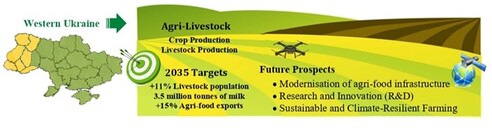
Some 3.6 million people are economically active in the Western region of Ukraine, of whom 840 000 (23 per cent) work in the agricultural sector. By December 2022, 860 900 people had migrated to the Western region following Russia’s military invasion. Given its favourable physical and geographical location, abundant natural and human resources, and an unpolluted environment suited to agricultural development under a warming climate, the Western region of Ukraine is regarded as economically and socially promising. Measures are proposed to set the region on a path towards sustainable, environmentally safe, and intersectorally balanced development of agricultural production and stockbreeding in the short and long term.
Downloads
References
Keulertz, M., Woertz, E., & Gilmont M., 2024, Europe’s Brazil. How Ukraine could transform Europe’s role in global food supply. International Journal of Environmental Studies 81(1) 169-176. https://doi.org/10.1080/00207233.2024.2313337
State Statistics Service of Ukraine, 2025, Sown areas of agricultural crops by crop type. https://www.ukrstat.gov.ua/
Marynych, A., Pashchenko, V., & Shyshchenko, P., 1985, Nature of the Ukrainian SSR: Landscapes and physical-geographical regionalisation (Kyiv: Naukova Dumka)
Martyn, A., Osypchuk, S., & Chumachenko, O., 2015, Natural–agricultural regionalisation of Ukraine (Kyiv: Comprint)
Krupskyi, N., & Polupan, N. (eds), 1979, Atlas of soils of the Ukrainian SSR. (Kyiv: Urozhai)
Ivanyuk, H., Yamelynets, T., Papish, I., Hnativ, P., Pankiv, Z., Bonishko, O., Ivaniuk, V., Haskevych, O., Baranskyi, D., & Avhustynovych, M., 2026, Soil classification of Ukraine and its correlation with WRB (2022). Soil Science Annual 77(1) 215263. https://www.soilsa.com/Issue-1-2026,16385
Truskavetskyi, R., 2007/2023, Soil-reclamation regionalization. In: Encyclopedia of Modern Ukraine. (Kyiv: Institute of Encyclopedic Research, National Academy of Sciences of Ukraine). https://esu.com.ua/article-25846
Hnativ, P., & Kachmar O., 2025, Climate fluctuations and weather conditions for crop farming in western Ukraine. Foothill and Mountain Agriculture and Animal Husbandry 77 (1) 41-54. https://doi.org/10.32636/01308521.2025-(77)-1-4
State Statistics Service of Ukraine, 2022, Employed population by economic activity and region. https://ukrstat.gov.ua/operativ/operativ2013/rp/zn_ed_reg/zn_ed_reg_u/arch_zn_ed_u.htm
Polovyy, V., Hnativ, P., Balkovskyy, V., Ivaniuk, V., Lahush, N., Shestak, V., Szulc, W., Rutkowska, B., Lukashchuk, L., Lukyanik, M., & Lopotych, N. 2021, The influence of climate changes on crop yields in Western Ukraine. Ukrainian Journal of Ecology 11(1), 384–390. https://doi.org/10.15421/2021_56
Lykhochvor, V., Hnativ, P., Petrichenko, V., Ivaniuk, V., Lahush, N., Shestak, V., Szulc, W., Rutkowska, B., Lukashchuk, L., Lukyanik, M., & Lopotych, N., 2022, Threat of degradation of agricultural land in Ukraine through a negative balance of nutritional elements in growing of field cultures. Journal of Elementology 27(3), 695-707. https://doi: 10.5601/jelem.2022.27.2.2290
Encyclopaedia Brittanica, 2024, Ukraine major export destinations. https://www.britannica.com/place/Ukraine/Finance
Sedilo, G., (eds), 2023, Dairy cattle breeding: breeding, technology, feeding (Obroshyne: IA KR NAAS)
Stasiv, O. (ed), 2022, Socio-economic models of development of the Carpathian region: economy, livestock (Obroshyne: IA KR NAAS)
Hnativ, P., & Stasiv, O., 2025, System analysis and agroecosystems (Obroshyne: IА KR NAAS). https://doi.org/10.32636/9786178433079/2
Bilovus, G., Voloshchuk, I., Hnativ, P., Ivaniuk, V., Lahush, N., Shestak, V., Szulc, W., Rutkowska, B., Lukashchuk, L., Lukyanik, M., & Lopotych, N., 2024, Agroecological foundations of agricultural production of the Western region (Obroshyne: IA KR NAAS).
Baystruk-Glodan, L., Khomyak, M., Peregrym, O., Hnativ, P., Ivaniuk, V., Lahush, N., Shestak, V., Szulc, W., Rutkowska, B., Lukashchuk, L., Lukyanik, M., & Lopotych, N., 2024, Scientific foundations of selection and seed production of perennial grasses in the Precarpathian region (Obroshyne: IA KR NAAS).
Karasevich, N., Marcinko, T., Begei, S., & Dziubaylo A., 2025, Ecological and agro-technological aspects of the formation of fodder productivity of perennial sown grasses in the Precarpathian region (Obroshyne: IA KR NAAS).
Downloads
Additional Files
Published
How to Cite
Issue
Section
License
Copyright (c) 2026 Petro Hnativ, Oleg Stasiv , Halyna Panahyd, Hryhoriy Konyk, Stakh Vovk

This work is licensed under a Creative Commons Attribution-NonCommercial 4.0 International License.
This work is licensed under a Creative Commons Attribution-NonCommercial 4.0 International License (CC BY-NC 4.0).
Readers may copy, distribute, and adapt the work for non-commercial purposes, provided the original author and source are credited.
For full licence details, please visit https://creativecommons.org/licenses/by-nc/4.0/.


