
Recovery from Emerald Ash Borer (Agrilus planipennis Fairmaire) Infestation in a Suburban Lake Environment
DOI:
https://doi.org/10.63095/NBSEH.26.231190Keywords:
Emerald ash borer (EAB), Green ash recovery, TexasAbstract
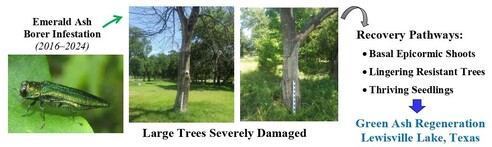
Field observations documented patterns of green ash (Fraxinus pennsylvanica) recovery following emerald ash borer (Agrilus planipennis Fairmaire) (EAB) infestation at Lewisville Lake in north-central Texas. A total of 119 trees were observed in three diameter classes along a 1 km nature trail. The trail winds through mown and unmown sections of remnant bottomland behind residential lots. Of the small (<2.5 cm), medium (2.5–15 cm), and large (>15 cm) diameter classes, large specimens suffered the most damage. None of the 31 large trees were healthy, though several had healthy epicormic branches near the base of the tree. Most of the 15 medium-diameter trees survived and were thriving in unmown areas. All 73 seedlings in the smallest category were thriving at unmown sites. Land stewardship strongly influences tree recovery in the study area.
Downloads
References
Hunter, M. C. R., 2011, Impact of ecological disturbance on awareness of urban nature and sense of environmental stewardship in residential neighborhoods. Landscape and Urban Planning 101(2), 131–138. https://doi.org/10.1016/j.landurbplan.2011.02.005
Reid, C. E., Clougherty, J. E., Shmool, J. L. C., & Kubzansky, L. D., 2017, Is all urban green space the same? A comparison of the health benefits of trees and grass in New York City. International Journal of Environmental Research and Public Health 14(11), 1411. https://doi.org/10.3390/ijerph14111411
Donovan, G. H., Butry, D. T., Michael, Y. L., Prestemon, J. P., Liebhold, A. M., Gatziolis, D., & Mao, M. Y., 2013, The relationship between trees and human health: Evidence from the spread of the emerald ash borer. American Journal of Preventive Medicine 44(2), 139–145. https://doi.org/10.1016/j.amepre.2012.09.066
Poland, T. M., & McCullough, D. G., 2006, Emerald ash borer: Invasion of the urban forest and the threat to North America’s ash resource. Journal of Forestry 104(3), 118–124. https://doi.org/10.1093/jof/104.3.118
Faggi, A. M., Fujiwara, F., Anido, C., & Perelman, P. E. (2011). Use of tree bark for comparing environmental pollution in different sites from Buenos Aires and Montevideo. Environmental Monitoring and Assessment, 178(1-4), 237-45. https://doi.org/10.1007/s10661-010-1685-z
Kremer, D., Cavlovic, J., & Bozic, M. (2006). Growth characteristics of introduced green ash (Fraxinus pennsylvanica Marshall) and narrow-leaved ash (F. angustifolia L.) in lowland forest region in Croatia. New Forests, 31(2), 211-224. https://doi.org/10.1007/s11056-005-5176-y
Gilman, E. F., Hilbert, D., Watson, D. G., Klein, R., Koeser, A., & McLean, D. C. (2019). Fraxinus pennsylvanica: Green ash (Publication No. ENH425). (Gainesville: University of Florida IFAS Extension). https://doi.org/10.32473/EDIS-ST266-1993
Yetter, A. P., Havera, S. P., & Hine, C. S., 1999, Natural-Cavity Use by Nesting Wood Ducks in Illinois. The Journal of Wildlife Management 63(2), 630–638. https://doi.org/10.2307/3802652
Bartens, J., Day, S. D., Harris, J. R., Dove, J. E., & Wynn, T. M., 2008, Can urban tree roots improve infiltration through compacted subsoils for stormwater management? Journal of Environmental Quality 37(6), 2048–2057. https://doi.org/10.2134/jeq2008.0117
Selbig, W. R., Loheide, S. P., Shuster, W., Scharenbroch, B. C., Coville, R. C., Kruegler, J., Avery, W., Haefner, R., & Nowak, D., 2022, Quantifying the stormwater runoff volume reduction benefits of urban street tree canopy. Science of the Total Environment, 806(3), 151296. https://doi.org/10.1016/j.scitotenv.2021.151296
Sun, J., Koski, T.-M., Wickham, J. D., Baranchikov, Y. N., & Bushley, K. E., 2024, Emerald ash borer management and research: Decades of damage and still expanding. Annual Review of Entomology 69, 239–258. https://doi.org/10.1146/annurev-ento-012323-032231
U.S. Department of Agriculture, Animal and Plant Health Inspection Service. (2025, December 17). Emerald ash borer. https://www.aphis.usda.gov/plant-pests-diseases/eab
Koch, J. L., Carey, D. W., Mason, M. E., Poland, T. M., & Knight, K. S., 2015, Intraspecific variation in Fraxinus pennsylvanica responses to emerald ash borer (Agrilus planipennis). New Forests 46, 995–1011. https://doi.org/10.1007/s11056-015-9500-9
Hudak, P. F., 2025, Emerald ash borer (Agrilus planipennis Fairmaire) damaging bottomland forest in north-central Texas, USA. Environmental Quality Management 34(3), 1-6. https://doi.org/10.1002/tqem.70033
McCullough, D. G., & Siegert, N. W., 2007, Estimating potential emerald ash borer (Coleoptera: Buprestidae) populations using ash inventory data. Journal of Economic Entomology 100(5), 1577–1586. https://doi.org/10.1093/jee/100.5.1577
Aubin, I., Cardou, F., Ryall, K., Kreutzweiser, D., & Scarr, T., 2015, Ash regeneration capacity after emerald ash borer (EAB) outbreaks: Some early results. The Forestry Chronicle 91(3), 291-298. https://doi.org/10.5558/tfc2015-050
Downloads
Additional Files
Published
How to Cite
Issue
Section
License
Copyright (c) 2026 Paul Hudak

This work is licensed under a Creative Commons Attribution-NonCommercial 4.0 International License.
This work is licensed under a Creative Commons Attribution-NonCommercial 4.0 International License (CC BY-NC 4.0).
Readers may copy, distribute, and adapt the work for non-commercial purposes, provided the original author and source are credited.
For full licence details, please visit https://creativecommons.org/licenses/by-nc/4.0/.


