
Long-Term Effect of Flocculated Sewage Sludge on Growth of Poplar under Drought Conditions.
DOI:
https://doi.org/10.63095/NBSEH.25.580341Keywords:
Poplar, Growth parameters, Technosol, Heavy metalsAbstract
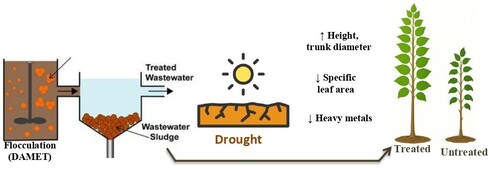
Poplar is popular for protective forest plantations and raw material for renewable energy and other industries. A long-term experiment with the Robusta clone to determine the effect of untreated and flocculant-treated sewage sludge was established on phyto-remediated loess-like loam at the DSAEU Land Reclamation Research Station in the Dnipropetrovsk region with applications of 20, 40 and 60 t/ha of both untreated and flocculated sludge. In the sixth year, in comparison to the control, the flocculated sewage sludge increased the average tree height and diameter of the three variants by 11 and 19.5%, respectively; somewhat less in the case of untreated sludge. The specific leaf area in the variants receiving flocculated sewage sludge was lower than in those receiving untreated sludge by 13-23%. Under drought conditions, the combination of greater organic matter and nitrogen and lower content of heavy metals in the flocculated sewage sludge was more favourable for the growth of poplar during six years of its cultivation.
Downloads
References
Kutsokon, N. A., Rakhmetov, D. B., Rakhmetova, S. O., Kulik, T. M., & Musienko, M. M., 2022, Nursery screening of poplar and willow clones for biofuel application in Ukraine. iForest 15(1), 401–410. https://doi.org/10.3832/ifor3732-015
Kharytonov, M. M., Rula, I. M., Fuchylo, Y. I., Didur, O. O., & Vasylchenko, R. S., 2020, Fast-growing poplar clones for production of biofuel feedstock on marginal lands. Bulletin of the Transilvania University of Braşov Series II: Forestry, Wood Industry, Agricultural Food Engineering 13(62,1), 37–48. https://doi.org/10.31926/but.fwiafe.2020.13.62.1.3
Szadkowska, D., Zawadzki, J., Kozakiewicz, P., & Radomski, A., 2021, Identification of extractives from various poplar species. Forests 12(5), 647. https://doi.org/10.3390/f12050647
Lin, C., Geiselman, G., Liu, D., Hunt, C., Hildebrand, A., & Ralph, J., 2022, Evaluation of engineered low-lignin poplar for conversion into advanced bioproducts. Biotechnology for Biofuels and By-products 15, 145. https://doi.org/10.1186/s13068-022-02245-4
Adiloglu, S., Gürgan, M., & Duban, S., 2024, Utilization of wastewater sludge and poplar trees for remediation. In V. Kumar, P. Singh, L. S. Thakur, & M. Shah (Eds.), Recent trends in management and utilization of industrial sludge (pp. 255–274). Springer. https://doi.org/10.1007/978-3-031-58456-5_9
Singh, B., Kaur, H., & Thakur, S., 2025, Effect of different nutrient sources including sewage sludge on growth performance and carbon sequestration potential of Melia azedarach and Eucalyptus tereticornis plantations. Journal of Soil Salinity and Water Quality 17(1), 100–109. https://doi.org/10.56093/jsswq.v17i1.165710
Kutsokon, N. A., Jose, S., & Holzmueller, E., 2015, A global analysis of temperature effects on Populus plantation production potential. American Journal of Plant Sciences 6(1), 23–33. https://doi.org/10.4236/ajps.2015.61004
Kharytonov, M., Babenko, M., Martynova, N., Rula, I., Sbytna, M., & Fuchilo, Y., 2017, The poplar saplings survival in reclaimed mine land depending on clone and root treatment. Agriculture and Forestry 63(4), 141–151. https://doi.org/10.17707/AgricultForest.63.4.16
Gaduš, J., Melišková, I., & Roháčiková, O., 2017, The cultivation of fast-growing trees on agricultural land in Slovakia and Czechia: legal comparison. Acta Regionalia et Environmentalica 14(2), 45–51. https://doi.org/10.1515/aree-2017-0007
Moffat, A. J., Armstrong, A. T., & Ockleston, J., 2001, The optimization of sewage sludge and effluent disposal on energy crops of short rotation hybrid poplar. Biomass and Bioenergy 20(3), 161–169. https://doi.org/10.1016/S0961-9534(00)00073-8
Kharytonov, M., Martynova, N., Babenko, M., Rula, I., Ungureanu, N., & Ștefan, V., 2023, Production of sweet sorghum bio-feedstock on technosol using municipal sewage sludge treated with flocculant, in Ukraine. Agriculture 13(6), 1129. https://doi.org/10.3390/agriculture13061129
Semenova, I., 2021, Spatiotemporal distribution of soil moisture content over Ukraine and its relationship to atmospheric conditions. Environmental Sciences Proceedings 4(1), 20. https://doi.org/10.3390/ecas2020-08117
Semenova, I., & Vicente-Serrano, S. M., 2024, Long-term variability and trends of meteorological droughts in Ukraine. International Journal of Climatology 44(6), 1849–1866. https://doi.org/10.1002/joc.8416
Andreiev, A., Lysenko, A., Golubov, S., Stankevich, S., Kozlova, A., & Artiushyn, L., 2025, Geoinformation tool for remote assessment of shelterbelts damaged by military actions. Ukrainian Journal of Remote Sensing 12(3), 12–20. https://doi.org/10.36023/ujrs.2025.12.3.290
Kharytonov, M., Lakyda, P., Matushevych, L., Andreiev, A., Kozlova, A., & Stankevich, S., 2025, Drought and airborne emissions in Dnipropetrovsk region, Ukraine. International Journal of Environmental Studies 82, 1–11. https://doi.org/10.1080/00207233.2025.2557141
Pichura, V., Potravka, L., & Dent, D., 2025, The Kakhovka Sea before and after the destruction of the Kakhovka Dam. Natural Built Social Environment Health 1(1), 104–133. https://doi.org/10.63095/NBSEH.25.290237
Vusić, D., Kajba, D., Andrić, I., Gavran, I., Tomić, T., Plišo Vusić, I., & Zečić, Ž., 2019, Biomass yield and fuel properties of different poplar SRC clones. Croatian Journal of Forest Engineering 40(1), 1–10. https://doi.org/10.5552/crojfe.2019.678
Ferus, P., Hnilička, F., Hniličková, H., Kurjak, D., Kmeť, J., Otepka, P., Gubiš, J., Havrlentová, M., Malbeck, J., & Konôpková, J., 2020, Productivity and heat-stress tolerance in Canadian poplar (Populus × canadensis Moench) clones with different ecological optimum. Biomass and Bioenergy 138, 105605. https://doi.org/10.1016/j.biombioe.2020.105605
Downloads
Additional Files
Published
How to Cite
Issue
Section
License
Copyright (c) 2025 Mykola Kharytonov, Mykhailo Babenko, Liubov Matushevych, Alla Samarska

This work is licensed under a Creative Commons Attribution-NonCommercial 4.0 International License.
This work is licensed under a Creative Commons Attribution-NonCommercial 4.0 International License (CC BY-NC 4.0).
Readers may copy, distribute, and adapt the work for non-commercial purposes, provided the original author and source are credited.
For full licence details, please visit https://creativecommons.org/licenses/by-nc/4.0/.


